Author Archives: EzraSidran

Computational military reasoning.

Computational military reasoning is a phrase that I coined to describe the process of a machine performing human-level analysis of tactical and strategic problems. I have spent the last 30 years of my life working on this problem. It was the theme of my doctoral research in computer science. The abstract for my doctoral dissertation reads:

We present here TIGER, a Tactical Inference Generator computer program that was designed as a test-bed program for our research, and the results of a series of surveys of Subject Matter Experts (SMEs) testing the following hypotheses:

Hypothesis 1:  There is agreement among military experts that tactical situations exhibit certain features (or attributes) and that these features can be used by SMEs to group tactical situations by similarity.

Hypothesis 2:  The best match (by TIGER of a new scenario to a scenario from its historical database) predicts what the experts would choose.

We have conducted three surveys of SMEs and have concluded that there is, indeed, a statistically significant confirmation of Hypothesis 1, that there is agreement among military SMEs that tactical situations exhibit certain features (or attributes) and, that these features can be used to group, or identify, similar tactical situations. The statistical confidence level for this confirmation of Hypothesis 1 is greater than twice the prior probability.

In order to test Hypothesis 2 we constructed, after SME survey analysis, a series of algorithms, which we present here, for the analysis of SME identified tactical features (or attributes) including: interior lines, restricted avenues of approach, restricted avenues of attack, slope of attack, weighted force relationships and anchored or unanchored flanks. Furthermore, the construction, and implementation, of these algorithms, required the design and implementation of certain ‘building block’ algorithms including: range of influence, optimal FindPath, ComputeGroupsByThreshold and ComputeGroupsByNumber.

We further present an overview of TIGER, itself, and the built-in utilities necessary for creating three-dimensional tactical situations, complete with terrain, elevation and unit types as well as our implementation of Gennari, Fisher and Langley’s CLASSIT classification system.

Lastly, we present TIGER’s classification of twenty historical tactical situations and five hypothetical tactical situations and the SME survey results of TIGER’s classification that resulted in TIGER correctly predicting what the SMEs would choose in four out of five tests (using a one sided Wald test resulted in p = 0.0001 which is statistically significant).

TIGER logo from my doctoral research.

TIGER logo from my doctoral research.

The entire dissertation can be downloaded here

I have also written a number of papers about implementing tactical maneuvers: “Implementing the Five Canonical Offensive Maneuvers in a CGF Environment,” which can be downloaded here. And “Algorithms for Generating Attribute Values for the Classification of Tactical Situations,” which can be downloaded here.

What will make General Staff stand out from other wargames is that it will be the first commercial computer wargame to implement this research. I have high hopes that General Staff will have the most advanced tactical AI ever produced in a computer wargame.
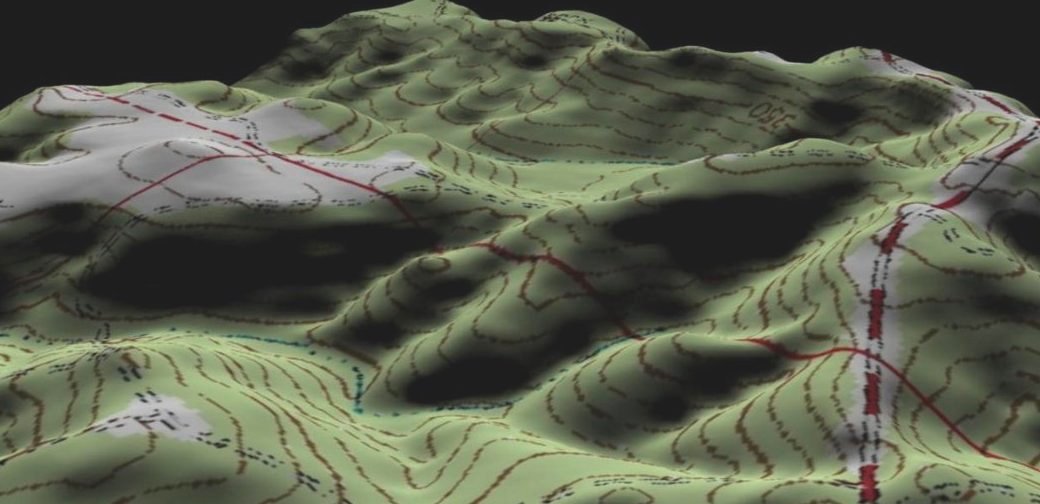
2D or not 2D (that is the question).

Let’s just start off by saying that General Staff will be in 3D. It’s the only way to display the blocks that represent units. But the question is: should the map be flat with just 3D unit blocks (simulating the original Kriegsspiel ) or should we employ a technique that I used for a project for the  U. S. Army in which a 2D topographical map was used as the skin for 3D elevation that was extrapolated at runtime from USGS (United States Geological Survey) data?

A screenshot of a project that I did for the Army. Click to enlarge.

A screenshot of a project that I did for the U. S. Army. Click to enlarge.

There are certainly pros and cons for both ideas. Frankly, I like the idea of using a flat, 2D, map with only the unit blocks in 3D. However, the one thing I don’t like about ‘traditional’ Kriegsspiel is that the unit blocks are rigid and always perfect rectangles that do not conform to map contours or allow units to change formations.

On the other hand, I’m concerned that if we go full 3D (like in the above screen capture), it’s going to be to similar to current 3D wargames (I won’t mention names, here).

I’ve tried to keep the overarching theme of ‘simplicity’ for General Staff in clear view. General Staff is supposed to be a fun, simple game where the graphics don’t get in the way of a pure tactical, enjoyable real-time game.

Either way, we will be employing my optimized 3D Line of Sight (LOS) algorithms. That is to say, units behind ridges will not be visible to opponents.

What do you think? Send us a note or leave a reply.

What does General Staff look like?

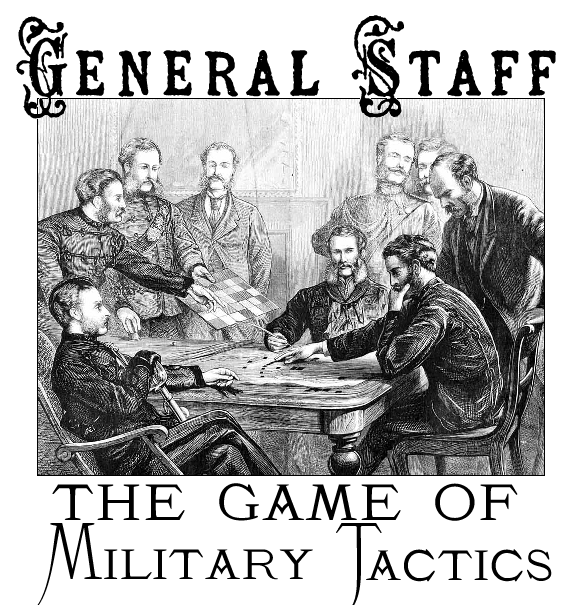
I tell my students that one of the first things they should do when creating a game is design a logo. This may not seem obvious or logical. Probably a lot of people leave designing a logo towards the end of a project. I think this is a mistake.

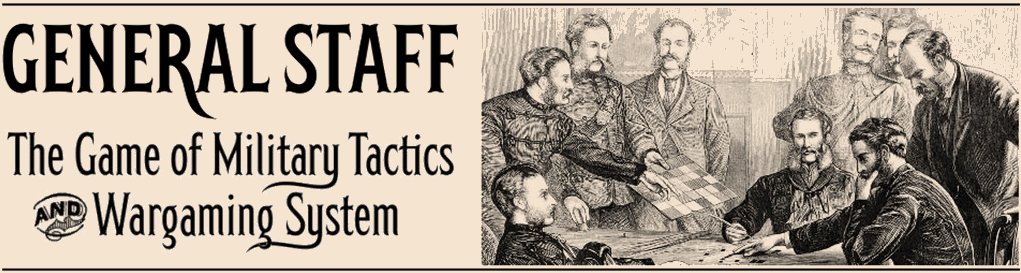
Click to enlarge.

Once you have a logo it shows everybody working on the project exactly what the feel and image is we’re working towards.

For General Staff I wanted a 19th century feel; something that brought back the original Kriegsspiel, old, faded maps and general staff officers in Napoleonic and Victorian uniforms. The type that I chose (Blaisdell and K22 Monastic) are classic Victorian fonts. The image in the logo is an engraving of the original Kriegsspiel being played; presumably in Prussia.

When you look at the General Staff logo it is obvious what the game looks and feels like; this is not a zombie chasing game, this is not an RPG, this is not Lara Croft, Tomb Raider (games that I all like and play, by the way). General Staff is a thinking game. It is a tactical game.

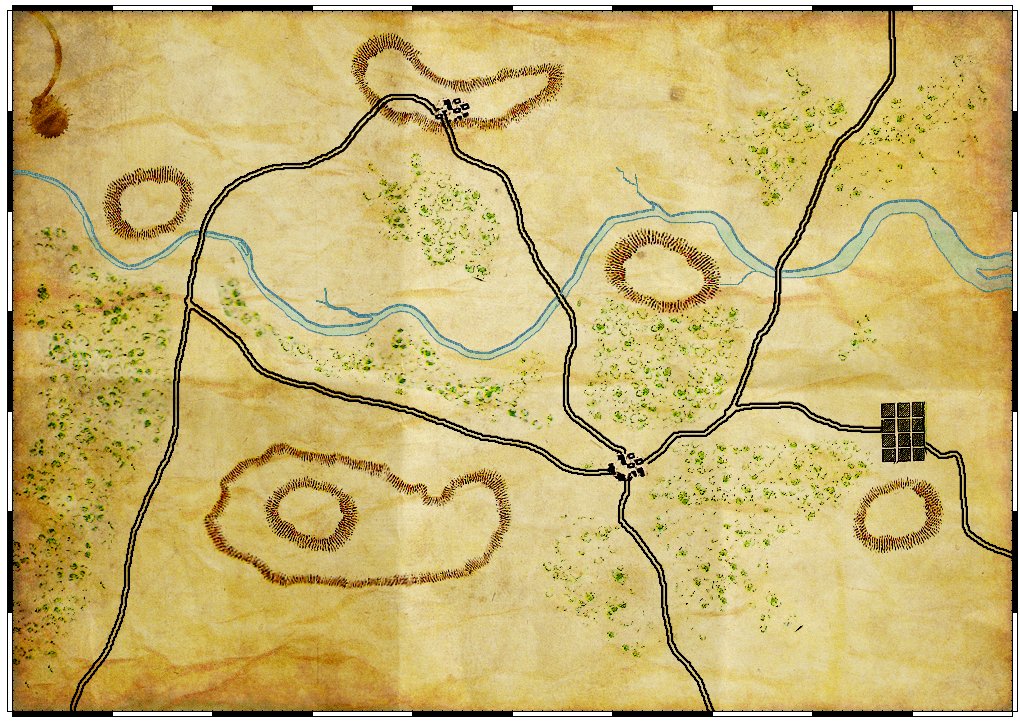
Ed Isenberg did a fantastic job creating the first map for General Staff.
He perfectly captured the feel of playing Kriegsspiel on an old map; complete with coffee stains and map folds.

The first General Staff battlefield.

The first General Staff battlefield. Click to enlarge.

Announcing a new computer wargame: General Staff!

I am extremely pleased to announce the development of my first new computer wargame in over twenty years: General Staff.  The decision to write a new wargame came about because I simply couldn’t find a computer wargame that I wanted to play. Yes, I know, there are dozens – if not hundreds – of really good computer wargames out there; but none of them appealed to me at the moment.

Most computer wargames have taken advantage of the ability of the computer to handle scores of complex rules and hundreds of units. This often resulted – and I want to make clear that as a designer I was also guilty of this – in massive wargames that weren’t all that fun to play. Sure, they were incredibly accurate. Indeed, I would market my wargames as simulations; because that’s what they were. And, truth be told, they were as good, if not better, than many computer simulations currently used by the world’s largest armies, Defense departments and ministries.

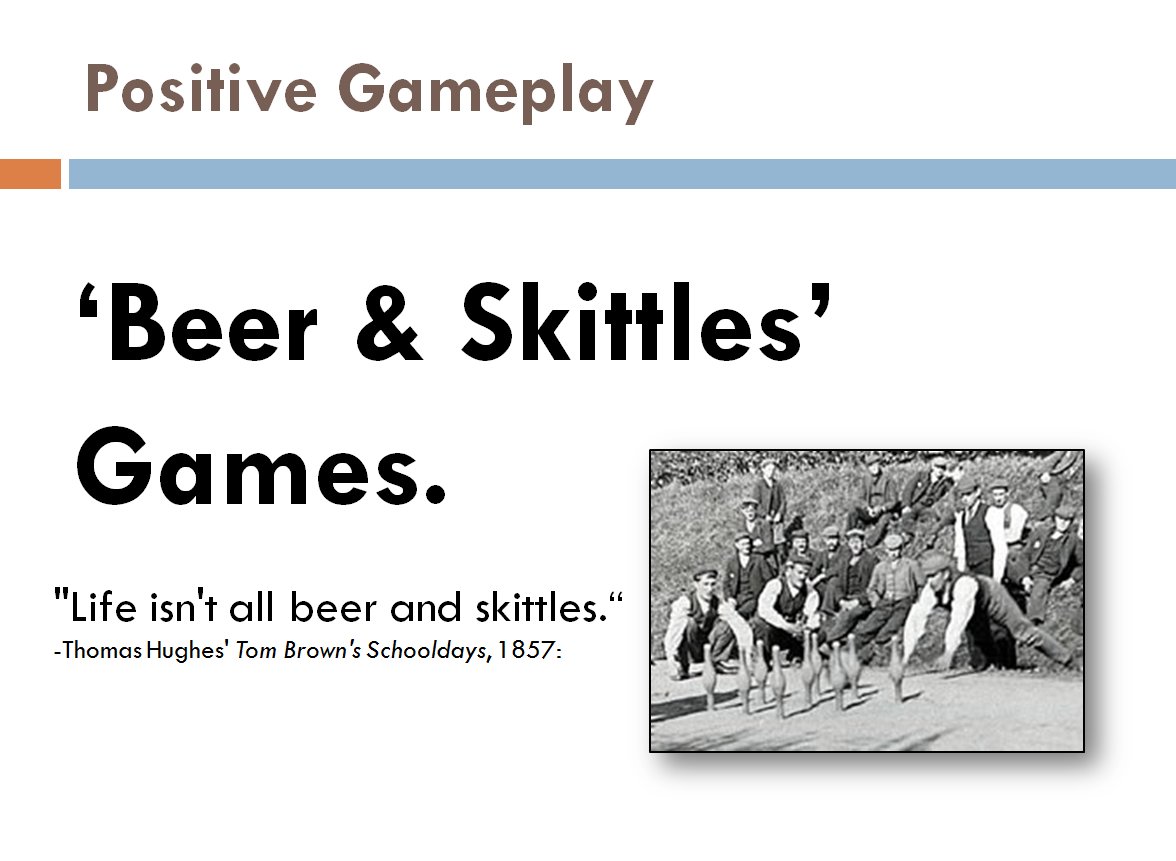
A slide from my Computer Game Design class at the University of Iowa.

A slide from my Computer Game Design class at the University of Iowa. Click to enlarge.

However, what I was looking for was something simple and fun. When I taught Computer Game Design at the University of Iowa I would tell my students that these kind of games were sometimes referred to as, “Beer & Skittles” games. They were simple, fun and addictive. Yes, I wanted to think (I didn’t want just a twitch game). I wanted something strategic or tactical; but I certainly didn’t want to get involved in micro-management of  logistics, factory production and national will. I just wanted to have fun.

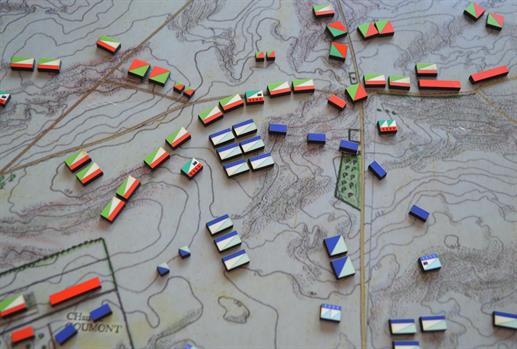
Modern Kriegspiel (Waterloo).

Modern Kriegsspiel. Click to enlarge.

About this time I read an article about wargaming in Nautilus magazine. The one thing that caught my eye was an illustration for the article of Kriegsspiel. Kriegsspiel was a  wargame invented in 1824 and used by the Prussian staff for training. A very good article about the original Kriegsspiel can be found here. It has been recreated from time to time and I recently found this picture of a modern version.

I don’t think there’s been a modern computer version done of Kriegsspiel; at least I haven’t been able to find one. So I decided to create it.

This blog will be about the development of General Staff. Your comments and questions will be greatly appreciated.