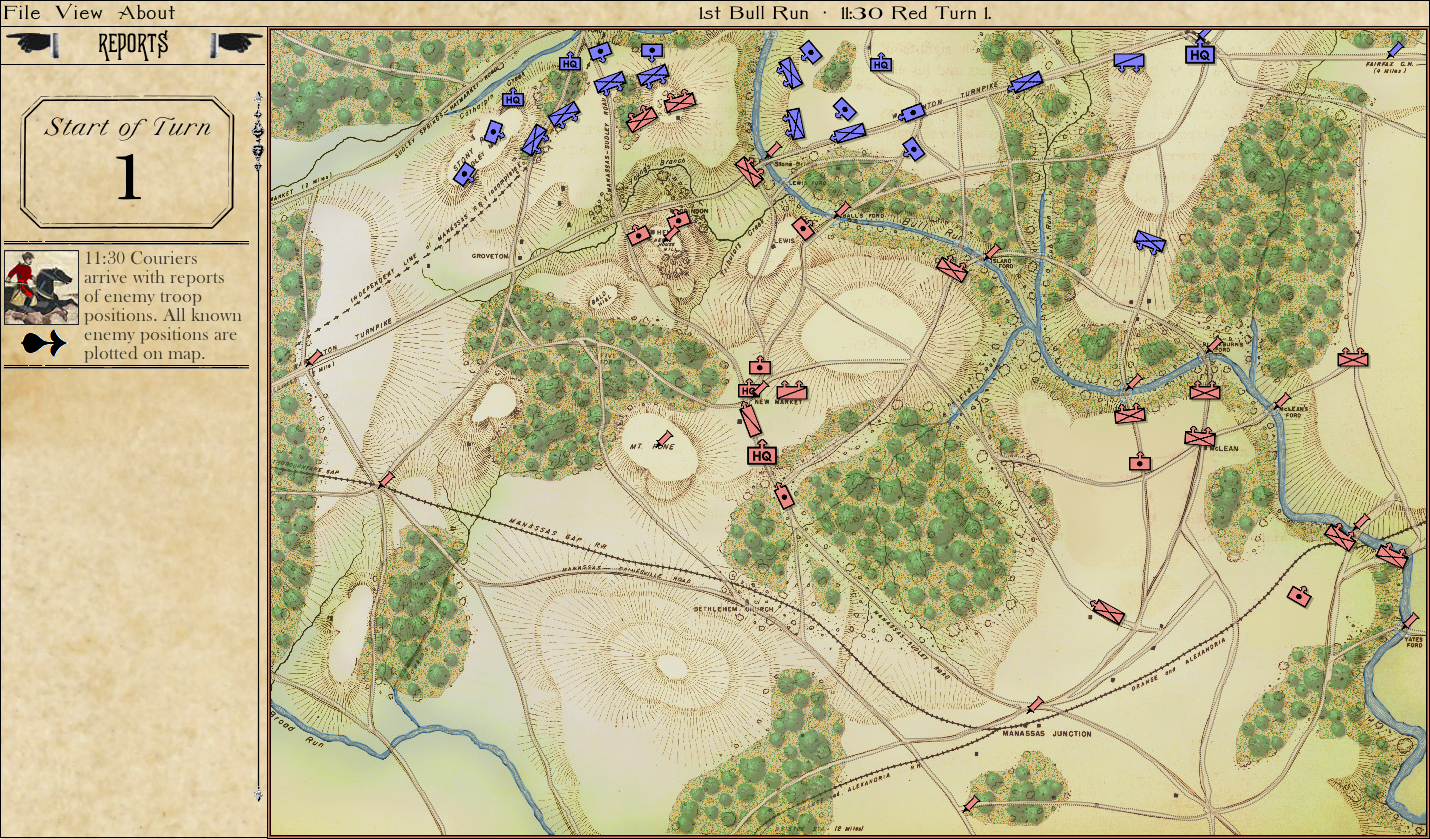
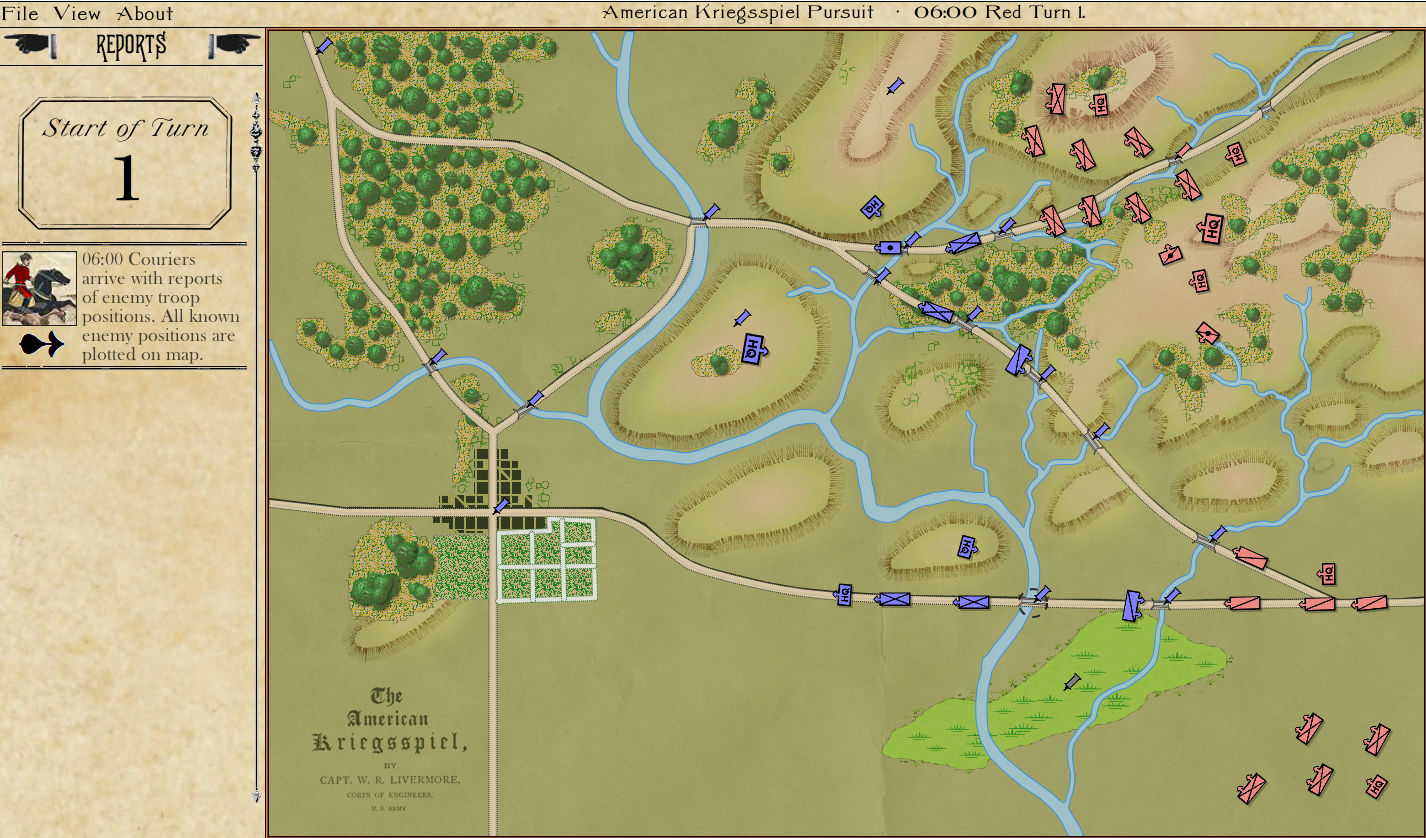
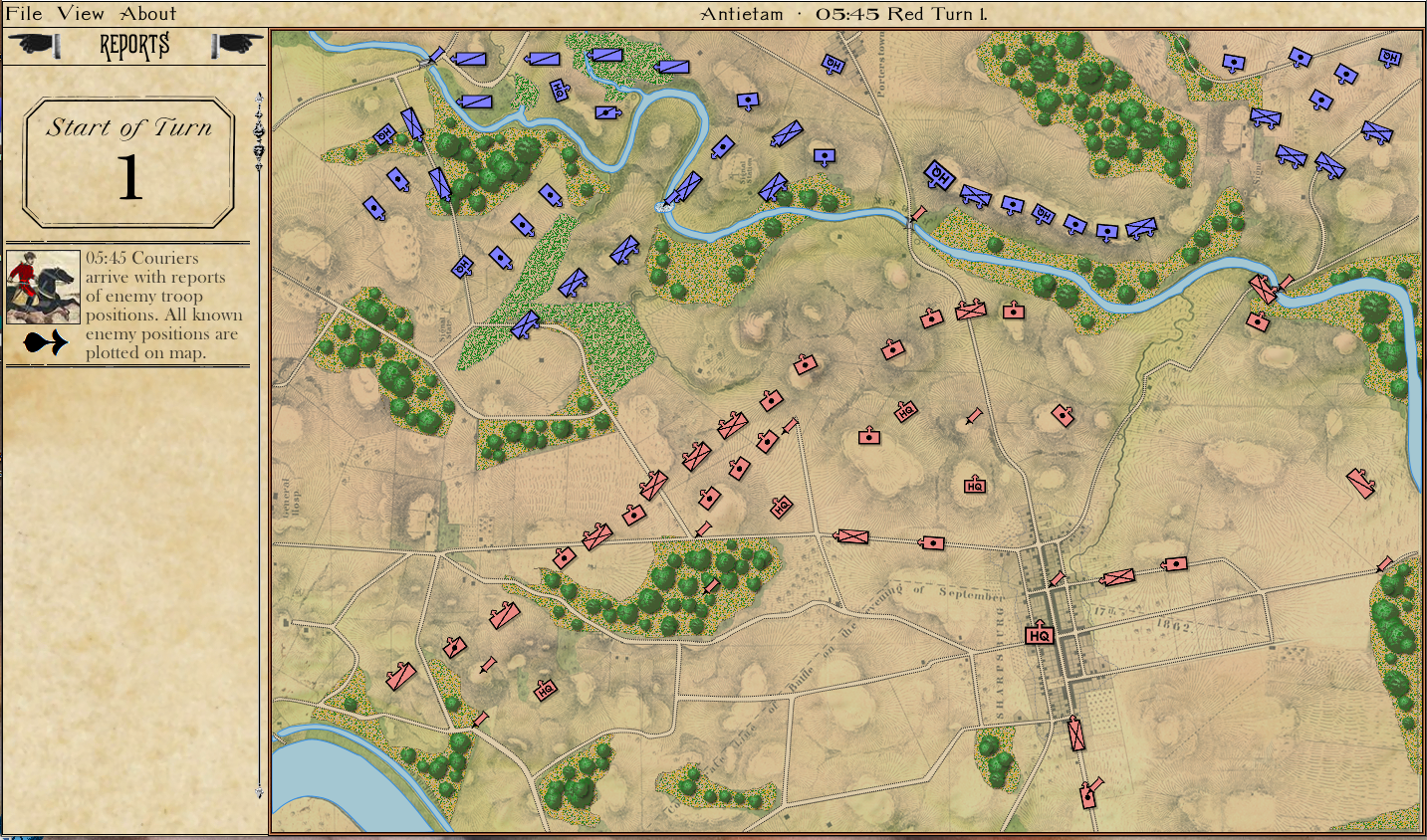
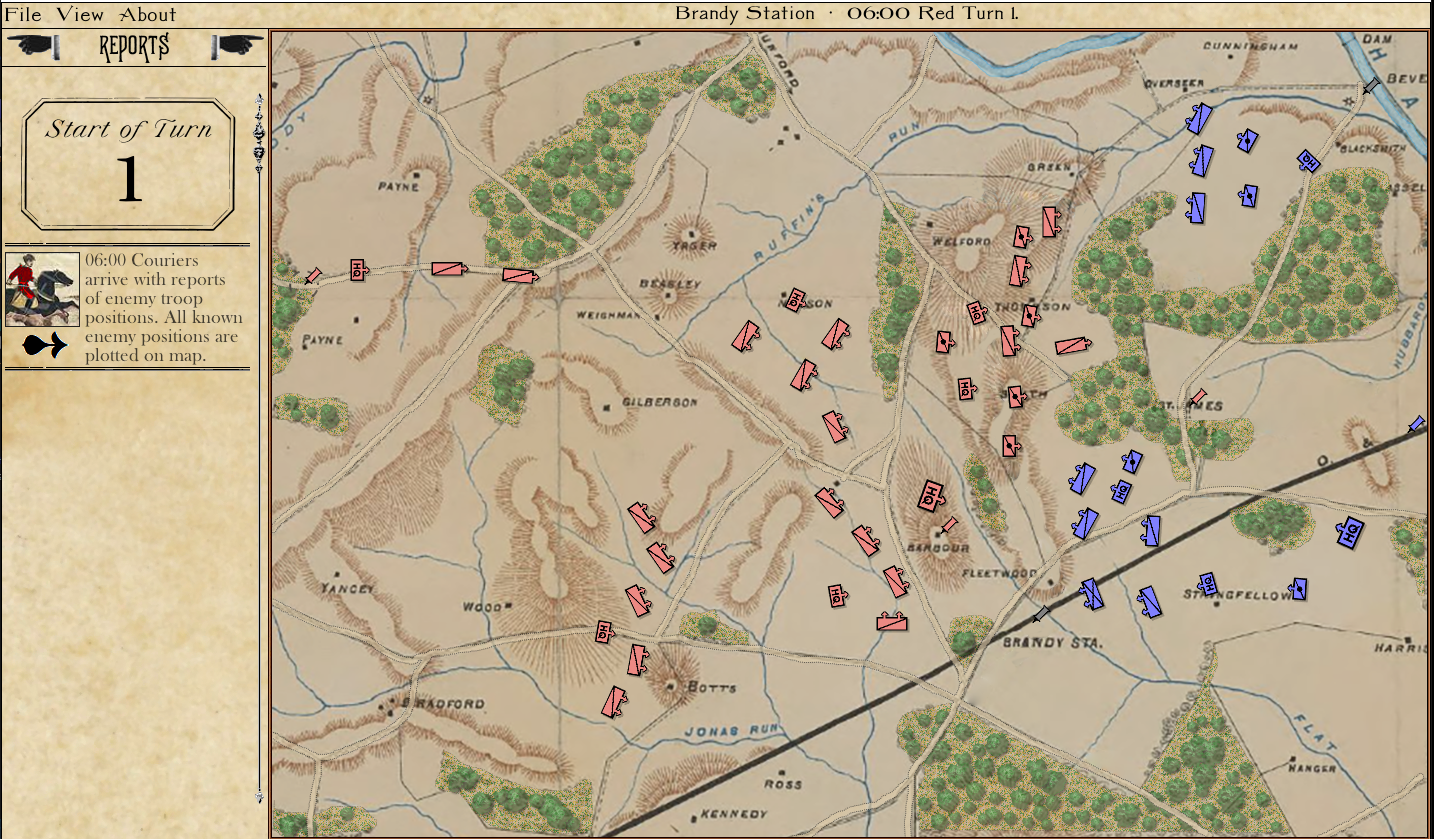
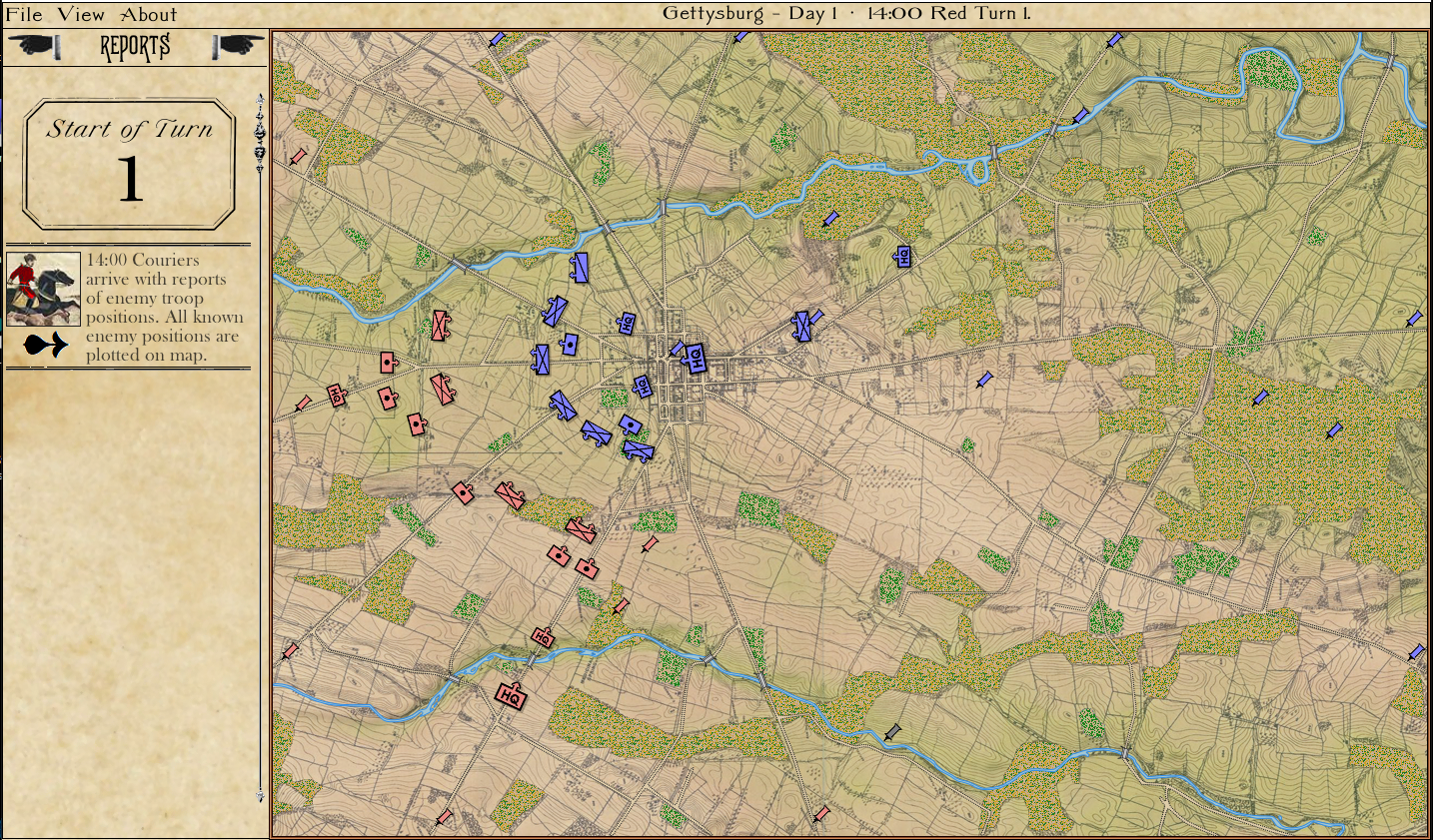
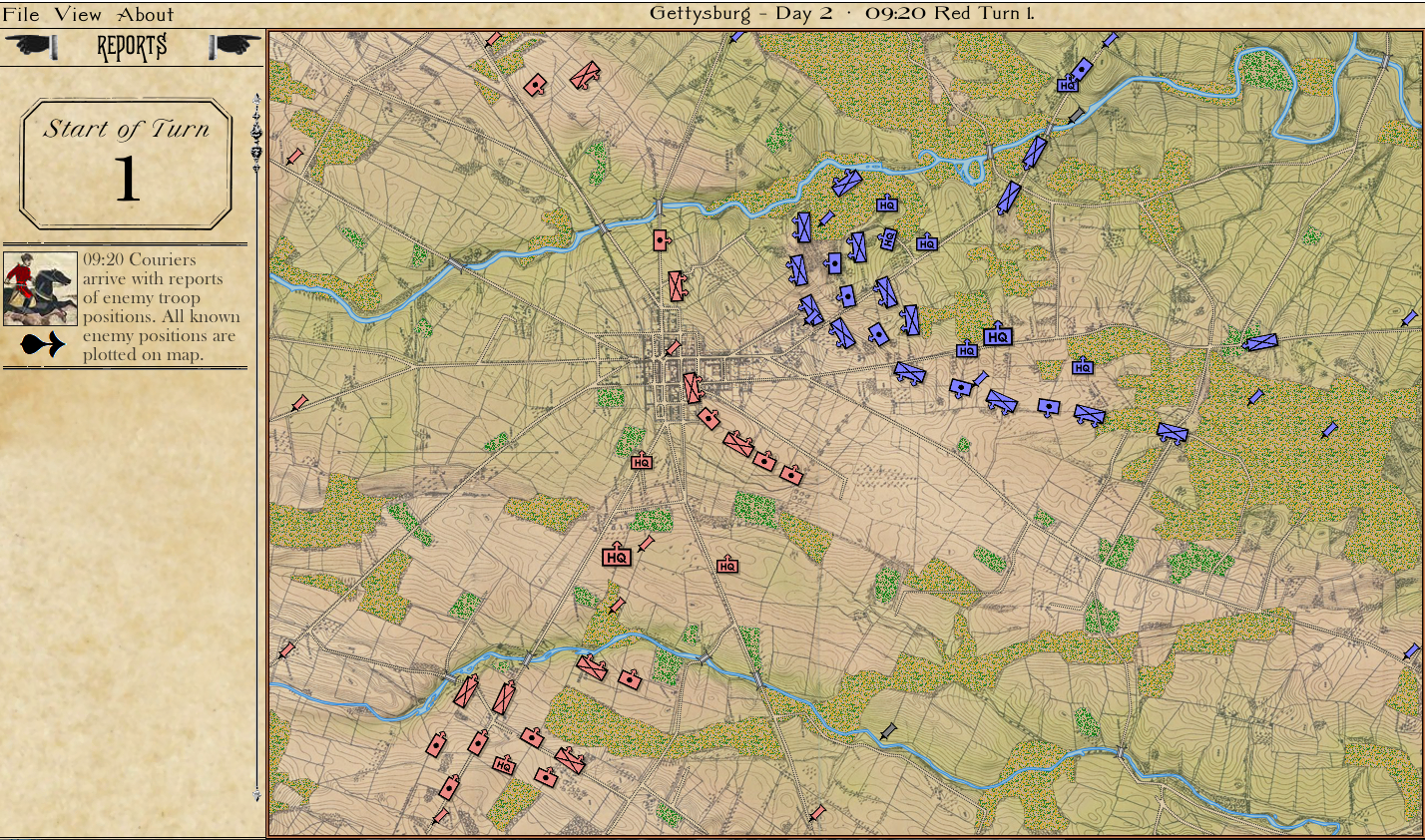
Screen shot of latest build of General Staff: Black Powder (June 20, 2026). Currently in beta-testing on Steam. Click to enlarge.
We are now officially in beta on Steam! Not only are doing the usual testing on the game engine, but we also need to test gameplay, player versus player real-time play, and player versus AI. Perhaps most importantly, we want to ship the game with fifteen to twenty solid scenarios for you to play. These scenarios have to be tested for accuracy and also the AI has to be run against them to see how the AI handles all kinds of different situations.
The scenarios that are currently up on Steam for testing are:
1st Bull Run, situation at 11:30 after Union troops have already crossed Bull Run and are attacking. Click to enlarge.
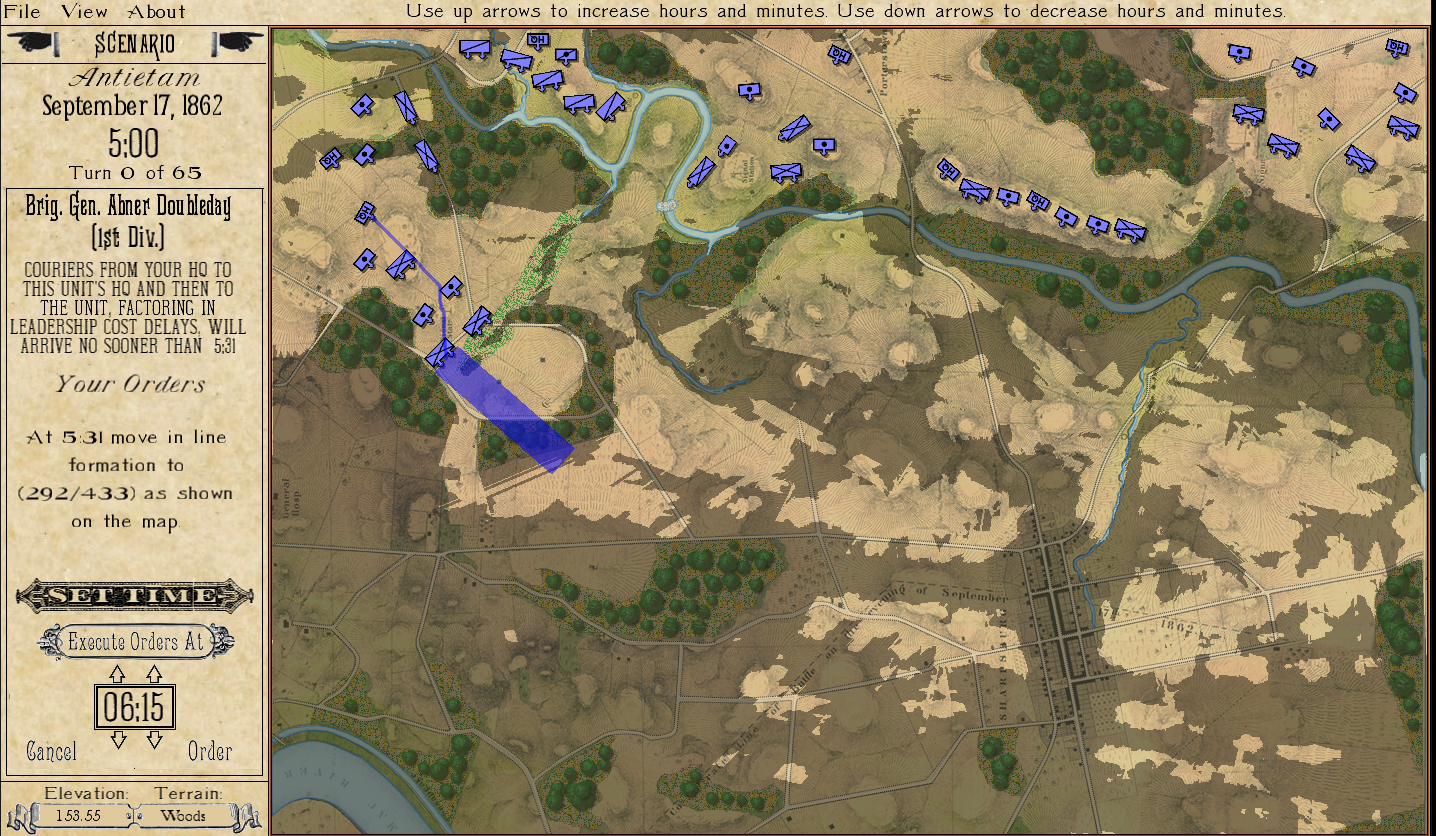
Antietam or Sharpsburg. The scenario begins at dawn with reinforcements arriving for both sides. Click to enlarge.
Brandy Station, the largest cavalry battle of the American Civil War. Designed by Mike Robel. Click to enlarge.
Gettysburg, day 1 (July 1, 1863). Starts at 1400 hours. Reinforcements are arriving. Click to enlarge
Gettysburg day 2, July 2, 1863, 9:20 AM. Reinforcements are pouring in. Click to enlarge.
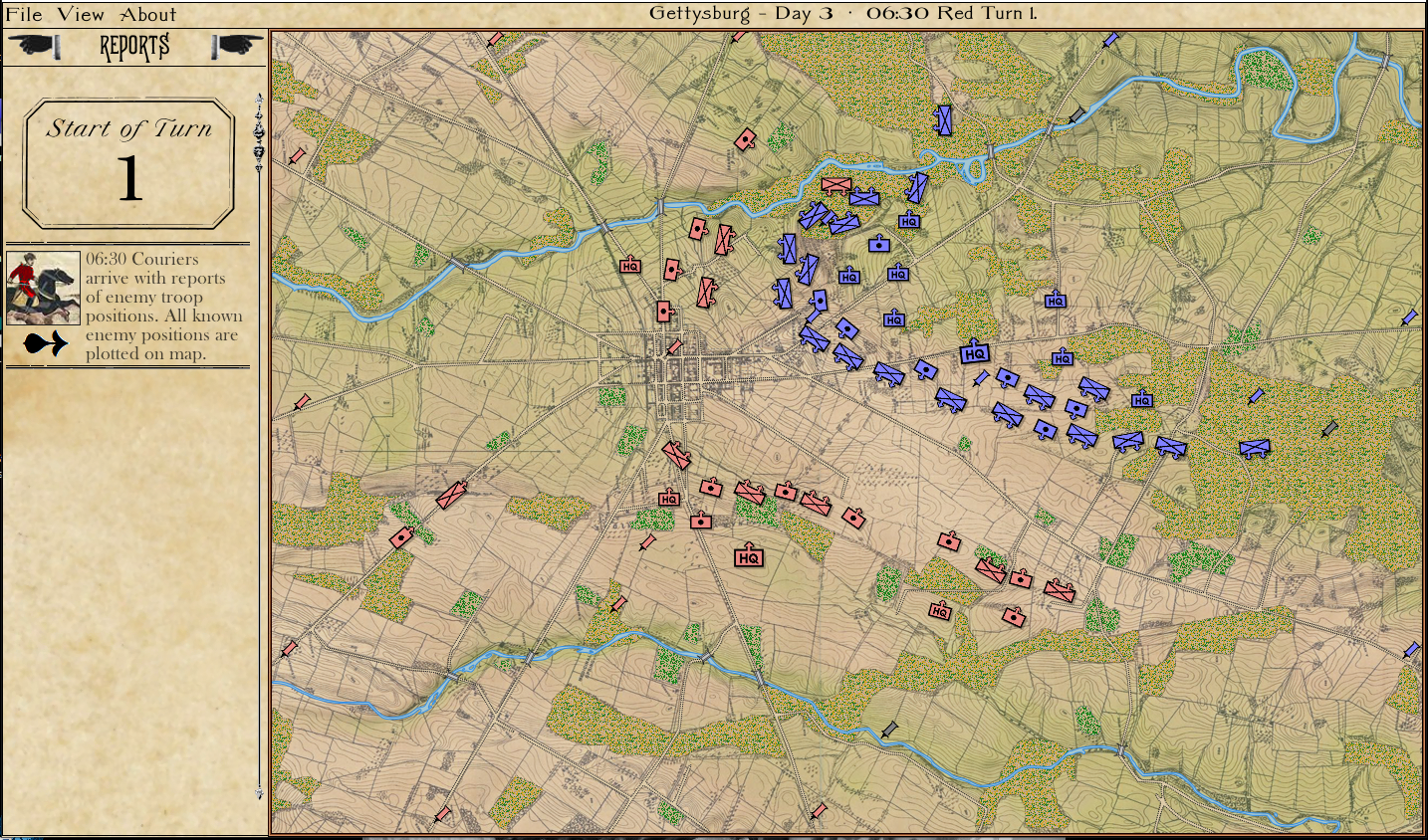
Gettysburg day 3 (July 3, 1863). One beta-tester asked if we could create multi-day battles using General Staff: Black Powder. The problem is that there is no concept of ‘night’ and night moves in the game. It could be added, but for now, let’s just get this game finished. Click to enlarge.
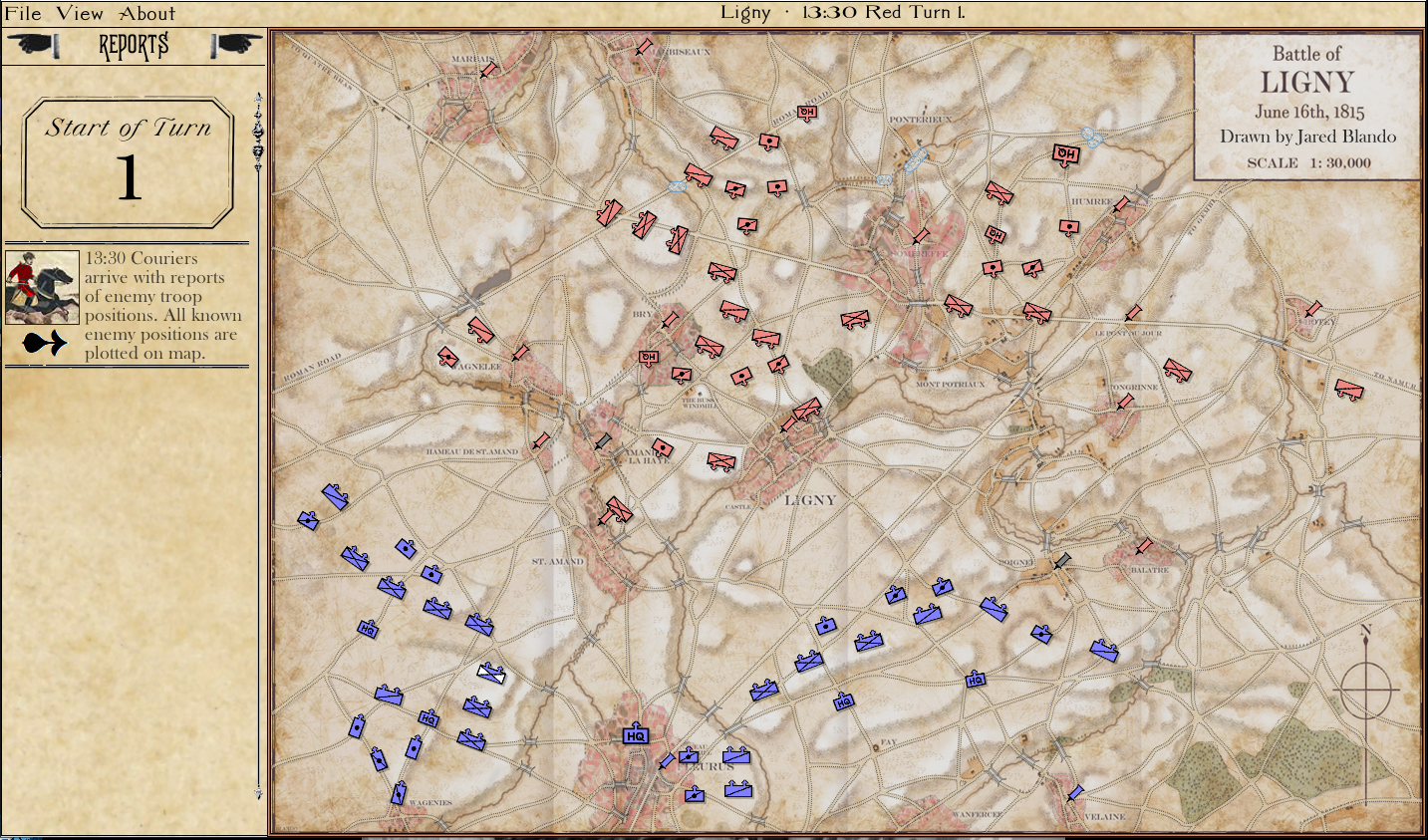
Ligny, June 16, 1815. Click to enlarge.
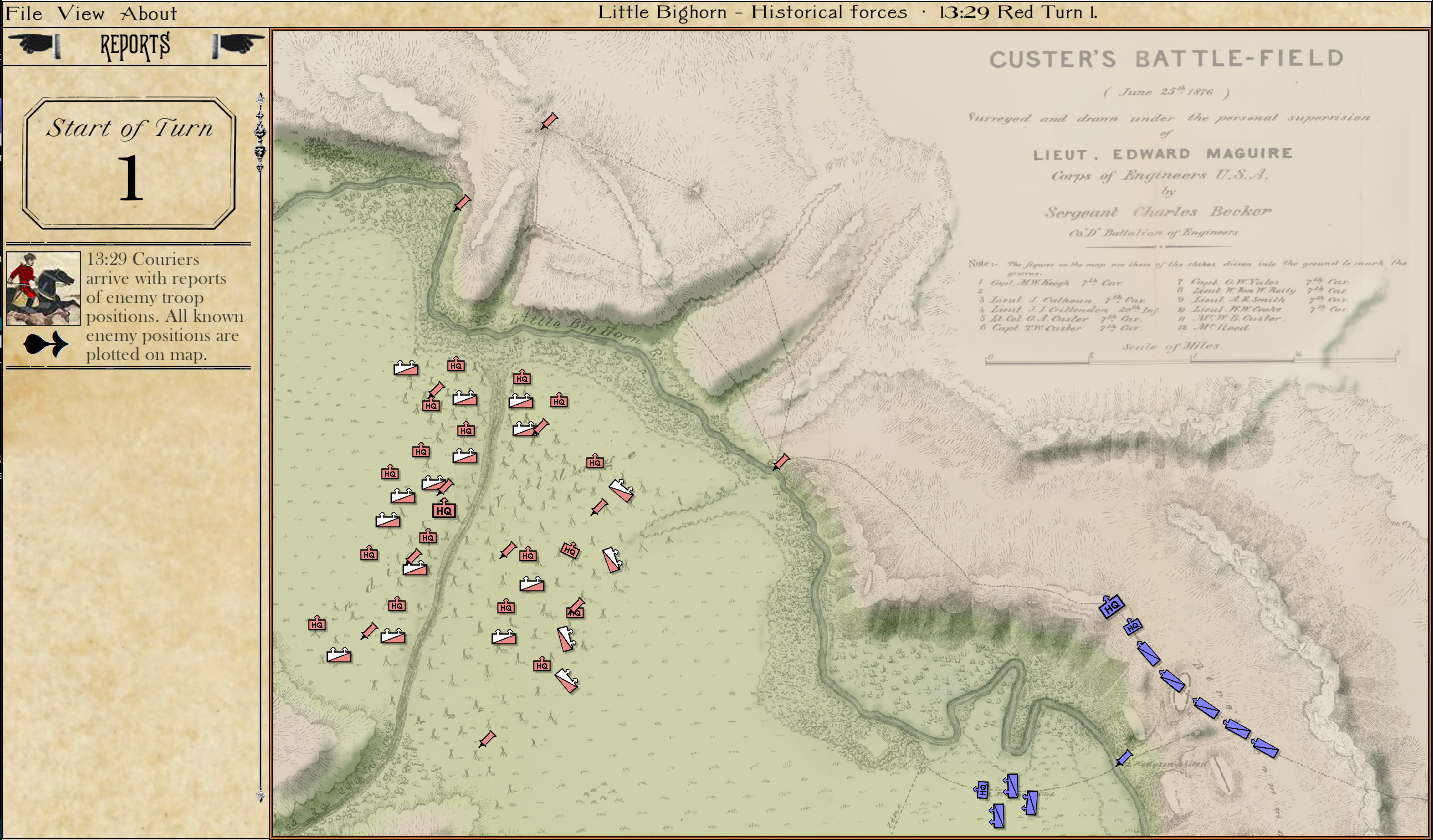
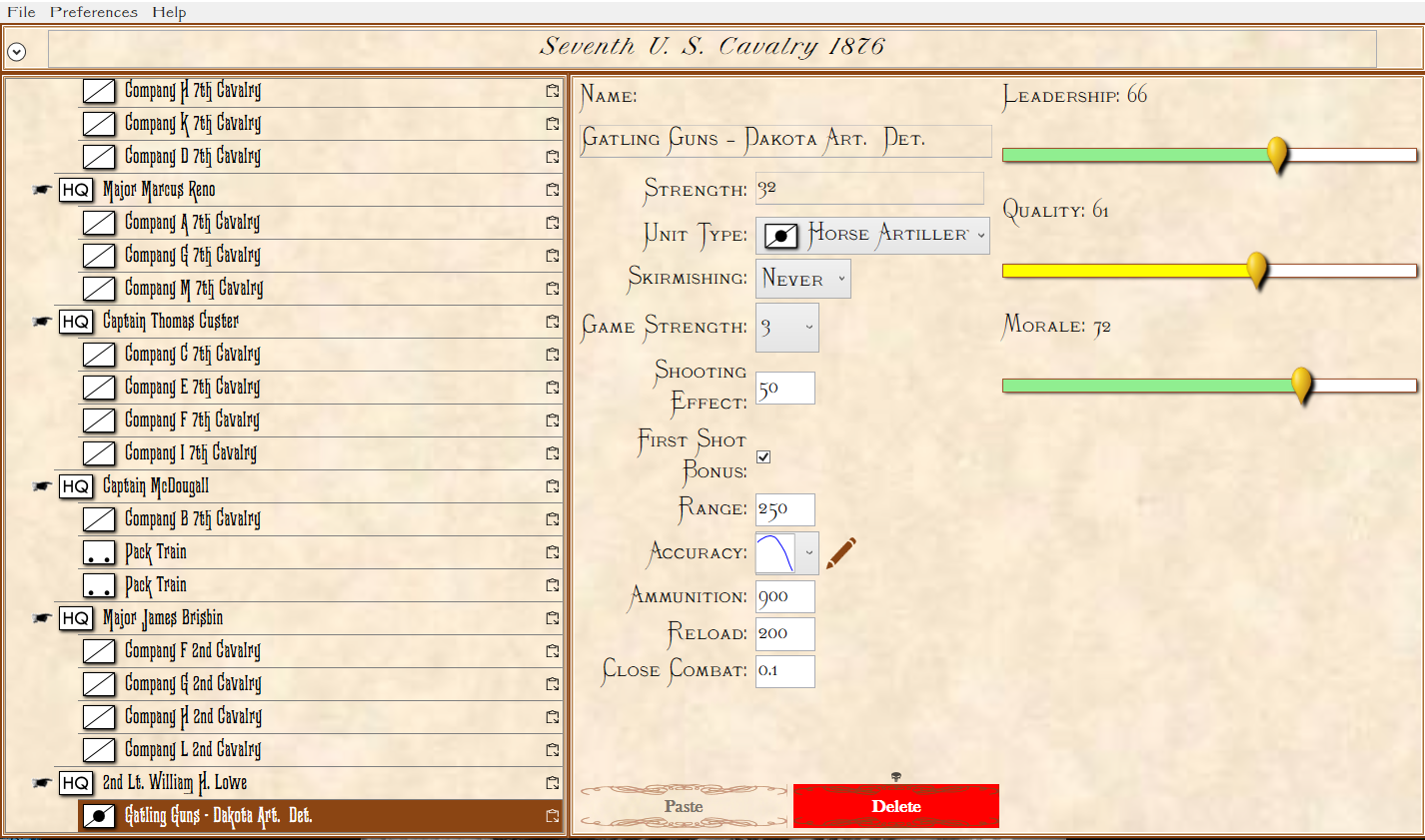
Little Big Horn with historical forces. Currently working on a scenario with an alternate OOB for the 7th cavalry including the Gatling guns that they didn’t take. Click to enlarge.
Alternate Order of Battle for the 7th cavalry at Little Big Horn. Screen shot from General Staff: Black Powder Army Editor. Click to enlarge.
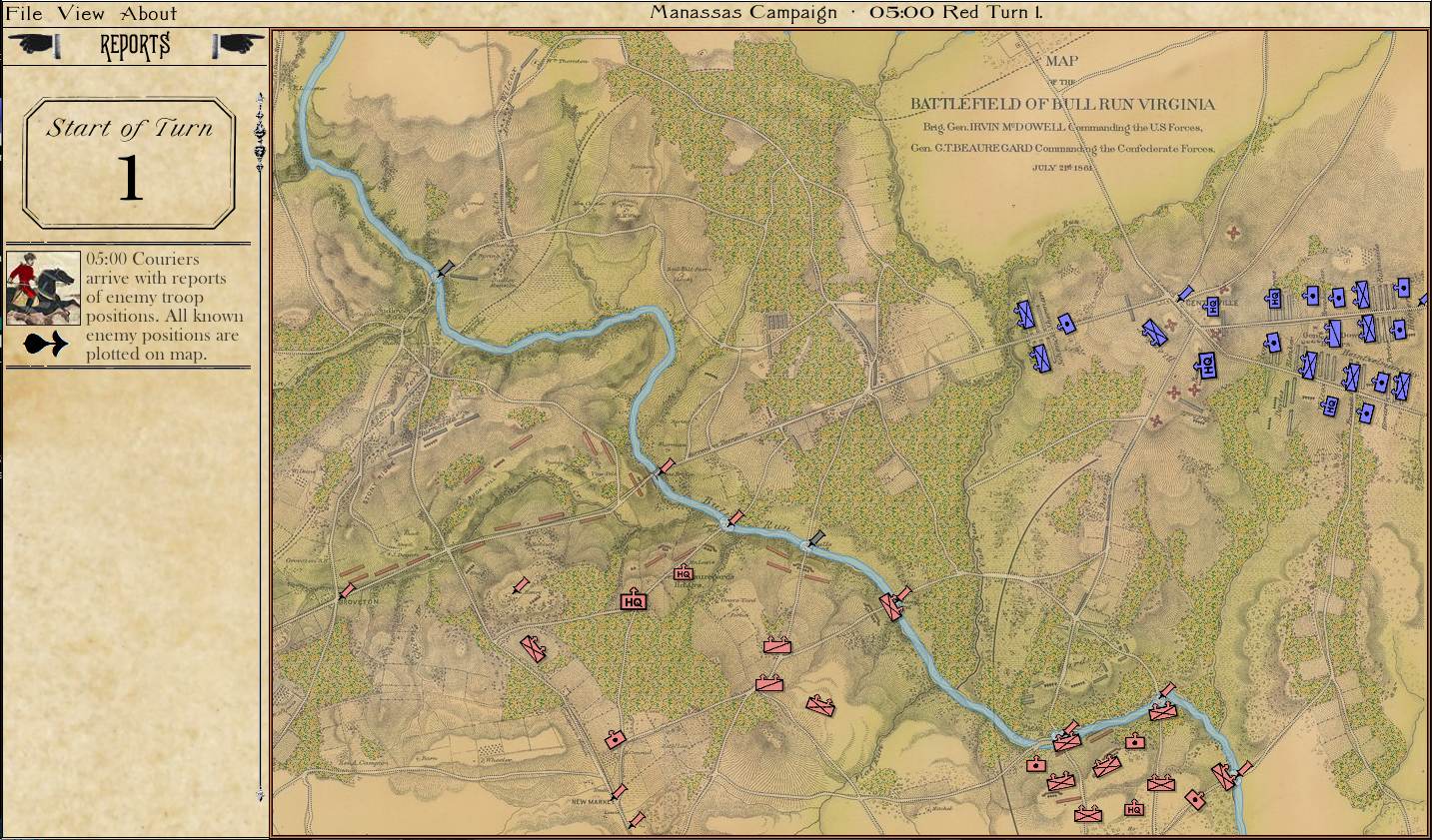
Manassas campaign about dawn. This scenario is earlier in the day than the 1st Bull Run scenario (above). We wanted to create a scenario that would test the AI with multiple water crossings. Click to enlarge.
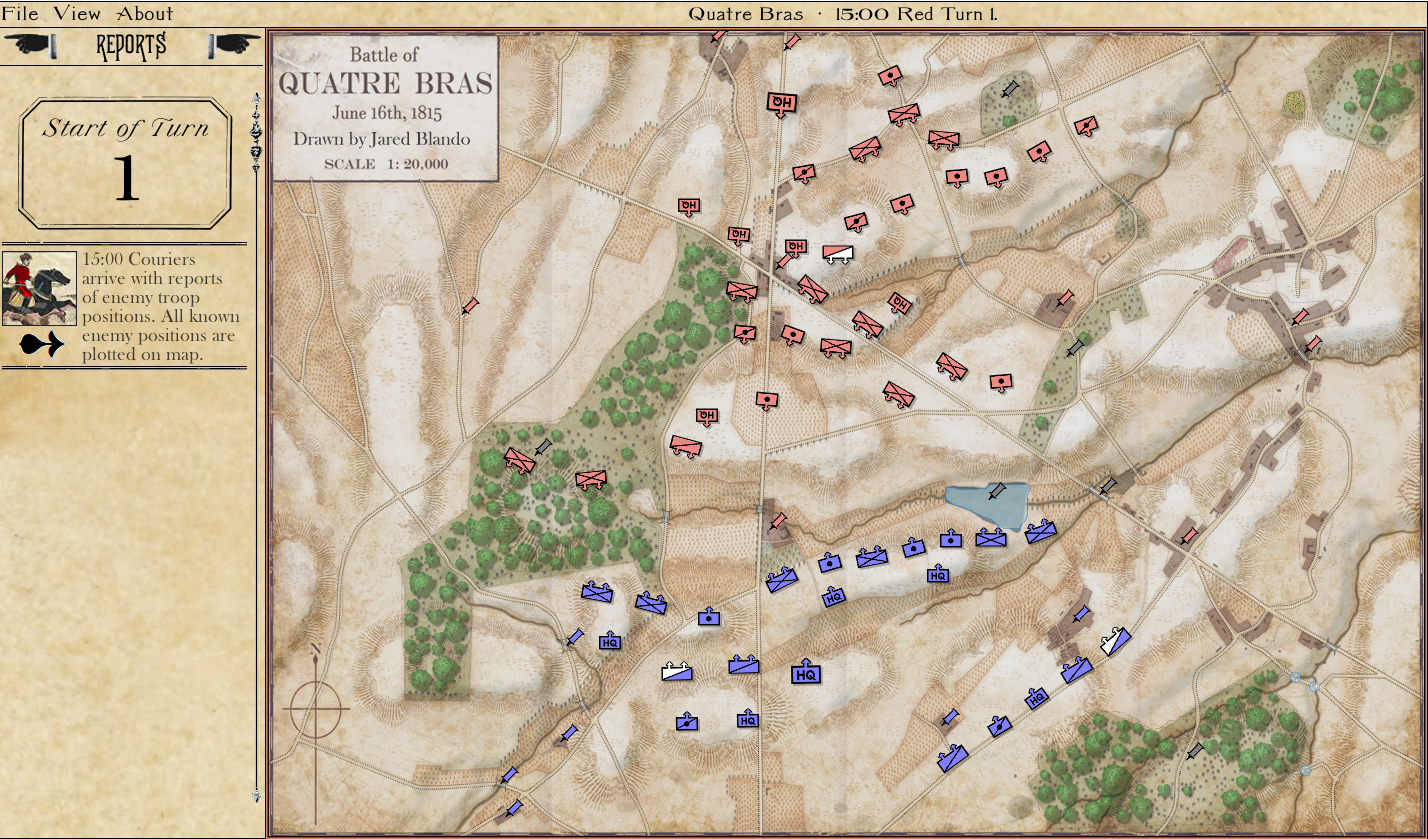
Quatre Bras, June 16, 1815. Click to enlarge.
If you are an early-backer or beta-tester (or want to beta-test):
We are still looking for more beta-testers. Please contact us at Betatester[at]RiverviewAI.com
Click on the above to launch a YouTube video about General Staff gameplay & AI.
This feels like a propitious moment; at least I’m drinking some decent scotch. I’ve got the AI that I’ve written ad nauseum about (links: papers, thesis) hooked up to the General Staff engine. This was something that, on paper, was supposed to be pretty easy but in the real world took far too long.
So, the short read is that if you want to take a look at what the General Staff AI engine looks like, please watch the video. It is mostly an offensive monster. It knows how to attack. It looks for open flanks. Then it looks for weak points on the line. Defense is difficult and there is still more work to do.
Also, we need more user created scenarios to test the AI on.
N.B. We don’t need more scenarios to train the AI. That’s not how MATE (Machine Analysis of Tactical Environments) works. It is a case-based reasoning AI. It is not a Large Language Model (LLM). It is not Grok, or ChatGPT, or Claude. Because it reasons. It – for lack of a better word – understands things. It understands what a flank is and it tries to turn it with its units. LLMs string words together that they’ve scraped from wherever and hope that you like them (they have a sycophancy reinforcement loop to optimize user engagement).
Someone fed one of my papers about TIGER (Tactical Inference Generator) into an LLM and asked it if it could perform this kind of reasoning. This was the reply:
Your skepticism is well-founded, and the paper you cite makes the reason precise rather than rhetorical.
The notion of an open or refused flank, as formalized in TIGER, is not a linguistic classification problem but a geometric and topological predicate over a continuous battlespace with adversarial constraints. In your formulation, a flank is anchored if and only if no BLUEFOR unit admits a legal path to a flanking objective that avoids REDFOR range-of-influence regions, where legality is defined with respect to terrain, slope, line of sight, and unit-specific mobility costs. That definition reduces to constrained path existence in a weighted graph whose edge weights and forbidden regions are dynamically induced by force disposition and terrain, not by labels or prior text. The algorithm explicitly constructs MST spines, computes continuous ROIs, projects objective points, and then solves repeated adversarial path-planning problems via A* or equivalent search. This is fundamentally an algorithmic decision procedure, not a pattern-completion task.
An LLM, by itself, cannot calculate this in any meaningful sense. It has no internal representation of continuous space, no native notion of reachability under constraints, no ability to execute minimum spanning tree construction, and no mechanism for guaranteeing correctness of a path-existence claim. At best, it can paraphrase the doctrine or restate the algorithm. It cannot answer the question “is the left flank refused?” without the explicit computational machinery you describe, because the answer is not a heuristic judgment but the outcome of a well-defined search problem.
Where the distinction becomes important is separating computation from orchestration. An LLM cannot replace the TIGER flanking algorithm any more than it can replace Dijkstra’s algorithm. However, it can sit above such machinery. Given access to the state representation and the outputs of ComputeGroupsByThreshold, CalculateROI, and FindPath, an LLM could reason symbolically about the results, explain why a flank is anchored, compare cases across battles, or assist a human analyst in interpreting why a particular BLUEFOR unit was forced through an ROI. In that role it is a narrative or analytic layer, not the reasoning engine itself.
Your broader point about Computational Military Reasoning stands: this class of military concepts only becomes machine-tractable when doctrine is grounded in geometry, graph theory, and constrained optimization. Anchored flanks, interior lines, and restricted avenues of approach are computable precisely because you reduced them to measurable invariants over space and movement. That reduction is what makes them suitable for case-based reasoning and unsupervised classification in systems like ClassIT, and it is exactly what an LLM does not do.
So the short answer is no: an LLM cannot calculate whether a flank is open or refused. The longer and more interesting answer is that your work shows why that question has a correct answer at all, and why tactical reasoning belongs to algorithms first and language models, if anywhere, only downstream of them.
I would just like to say that this LLM (above) wrote a superb analysis of my life’s work in computer science. Furthermore, it separated my work in cased base reasoning from its own LLM existence: It [an LLM] cannot answer the question “is the left flank refused?” without the explicit computational machinery you describe, because the answer is not a heuristic judgment but the outcome of a well-defined search problem.
I understand that there are fortunes, tenures, endowments, and founder’s stock to be won now in the race to LLMs, but I assure you, it is a parlor trick, it is simple word manipulation; it is a conjurer’s legerdemain.
To me the bon mot is, “An LLM cannot replace the TIGER flanking algorithm any more than it can replace Dijkstra’s algorithm.”
Dijkstra’s algorithm. I did my Q exam, my Qualifying Exam on Least Weighted Path algorithms. The Q exam comes around Year Three; it is where you have to demonstrate the ability to perform real research at a Research One University. Dijkstra’s algorithm is an exhaustive search and A* is a heuristic search. Dijkstra’s algorithm is guaranteed to find the optimal path, but it takes forever (O((V + E) log V)). While A* runs in (). If by some amazing luck of the draw you also have to defend this in your Q Exam, you just got all the answers you need to remember to move on to Round Four: your Comprehensive Exam (AKA, “The Comps”).
But, I digress. I confess that this was the first time I witnessed the AI act like this. Frankly, I was impressed when the AI unleashed the BLUE cavalry at the decisive moment towards the schwerpunkt. It was calculated using Kruskal’s Minimum Spanning Tree algorithm.
What I’m trying to say, and I have trouble explaining this without anthropomorphizing, but the MATE algorithms look at a snapshot of a battlefield, analyze it, perform numerous geometric calculations – especially those involving 3D line of sight (3D LOS), range of influence (ROI), locating flanking units, interior lines of communications, projections of force, etc. – and it comes up with a Course of Action (COA) that is, at least in the above video, better than what Major General George Brinton McClellan did at Antietam (in all candor, this is a pretty low bar). For starters, the AI is very aggressive and it hammered hard upon all three routes into Sharpsburg. Eventually RED’s left flank crumbled and the AI (BLUE) won.
Yeah, I’m proud of the AI. But, I need more scenarios to test the AI against. That’s where you come in. All the information is in the above video.
Click on the image below to see a step by step video tutorial of the Army Editor, Map Editor, and Scenario Editor as the battle of Brandy Station (June 9, 1863) is created using the General Staff: Black Powder Battle Designer Bundle.
Early Backers: If you did not get your Steam key please email Support@RiverviewAI.com. Thanks!
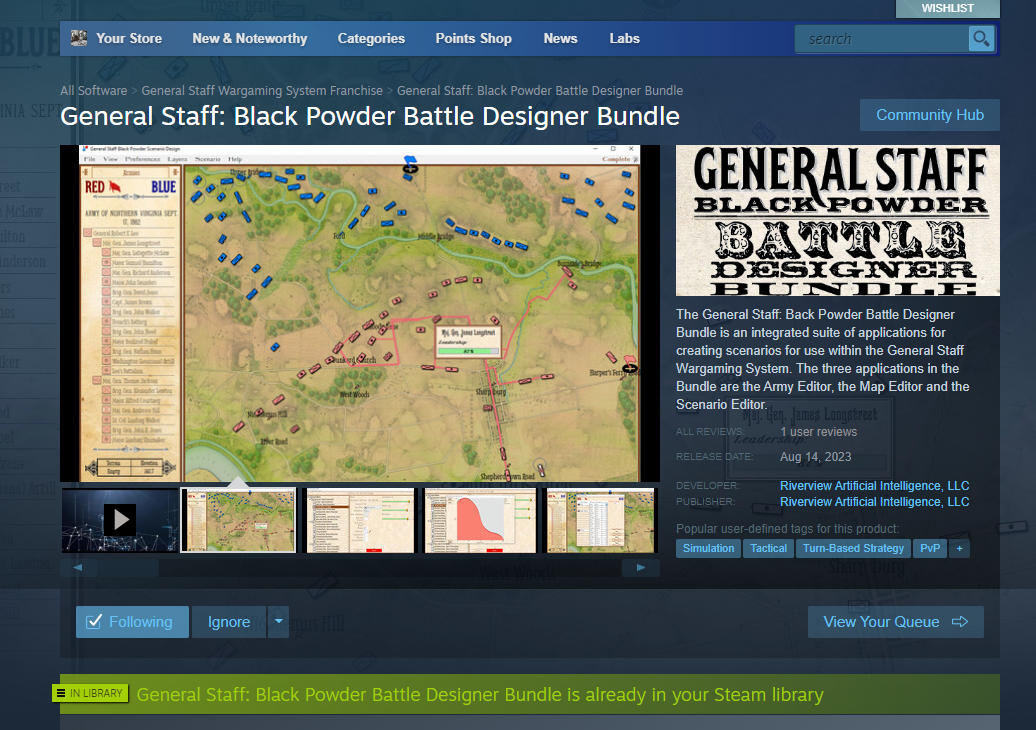
The General Staff: Black Powder Designer Bundle store on Steam. Click on image to go directly to the Steam store.
I am very pleased to announce that the Steam store for General Staff: Black Powder Battle Designer Bundle is now up and active. More importantly, if you are an early backer, you should have received your Steam key to download it by now. If you are an early backer and have not received an email with your Steam key, please contact me directly.
Some important things to know:
The Battle Designer Bundle does not include the actual game! The game is a different install package and, hopefully, will be in beta in the next month or two. If you are an early backer and received a Steam key for the Battle Designer Bundle you will also receive a second Steam key, when available, for the actual game and you will be welcome to participate in beta testing, too.
The Battle Designer Bundle includes everything you need to create your own armies, maps and scenarios for use in the actual game. The Battle Designer Bundle includes the Army Editor, the Map Editor and the Scenario Editor. The Map Editor supports a digitizing tablet (if you’re lucky enough to have one and the talent to use one, I don’t).
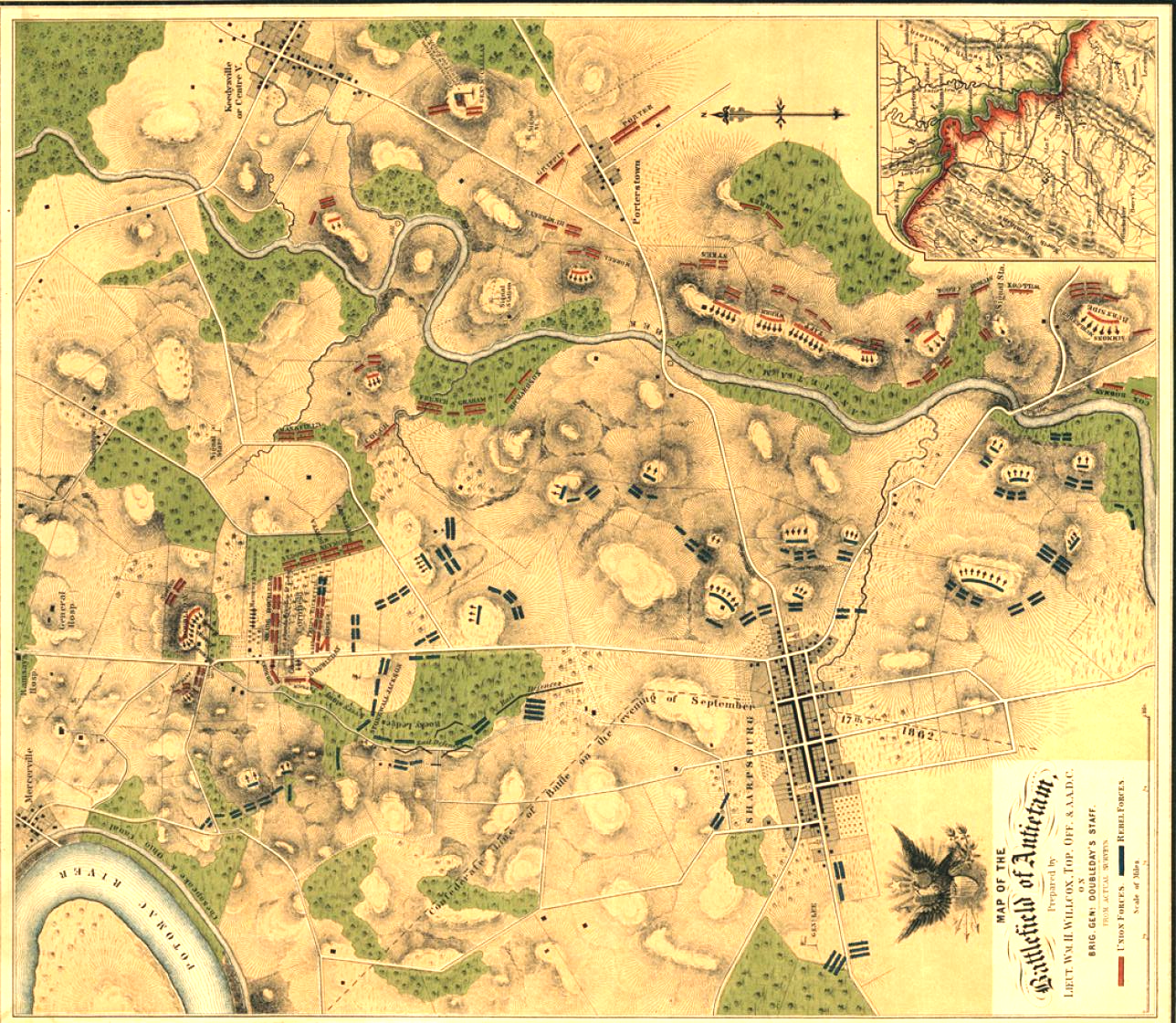
I need your suggestions for a battle that I can use to create video tutorials for the Army, Map and Scenario Editors. If you have suggestions, please contact me directly. However, it’s important to remember that I need a good Order of Battle (OOB) table that includes unit strengths. I also need a good quality map that is at least 1155 x 805 pixels (resolution). If it’s an old battle map, I need somebody to take the time to remove the units from the map. For example, here’s the original map of Antietam from the Library of Congress:
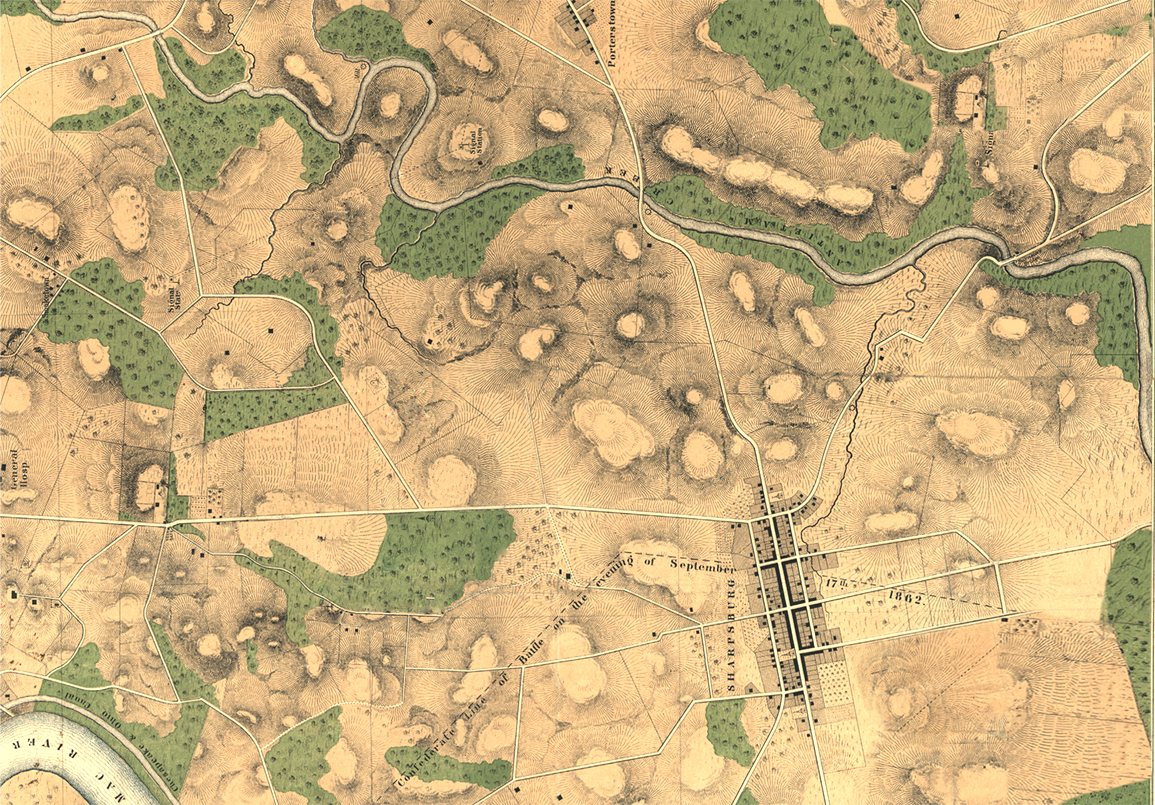
Map of the battle of Antietam from the Library of Congress. Willcox, William H. Map of the battlefield of Antietam. [Philada., Lith. of P. S. Duval & Son, 1862] Map. Click to enlarge.
And here it is after I cleaned it up, removed the units and rotated it 90 degrees:
The Antietam map after I removed all the units, cleaned it up, lightened it and rotated it 90 degrees. Click to enlarge.
I’m looking forward to receiving your scenario suggestions and creating the video tutorials. The tutorials will be posted here and on our YouTube channel.
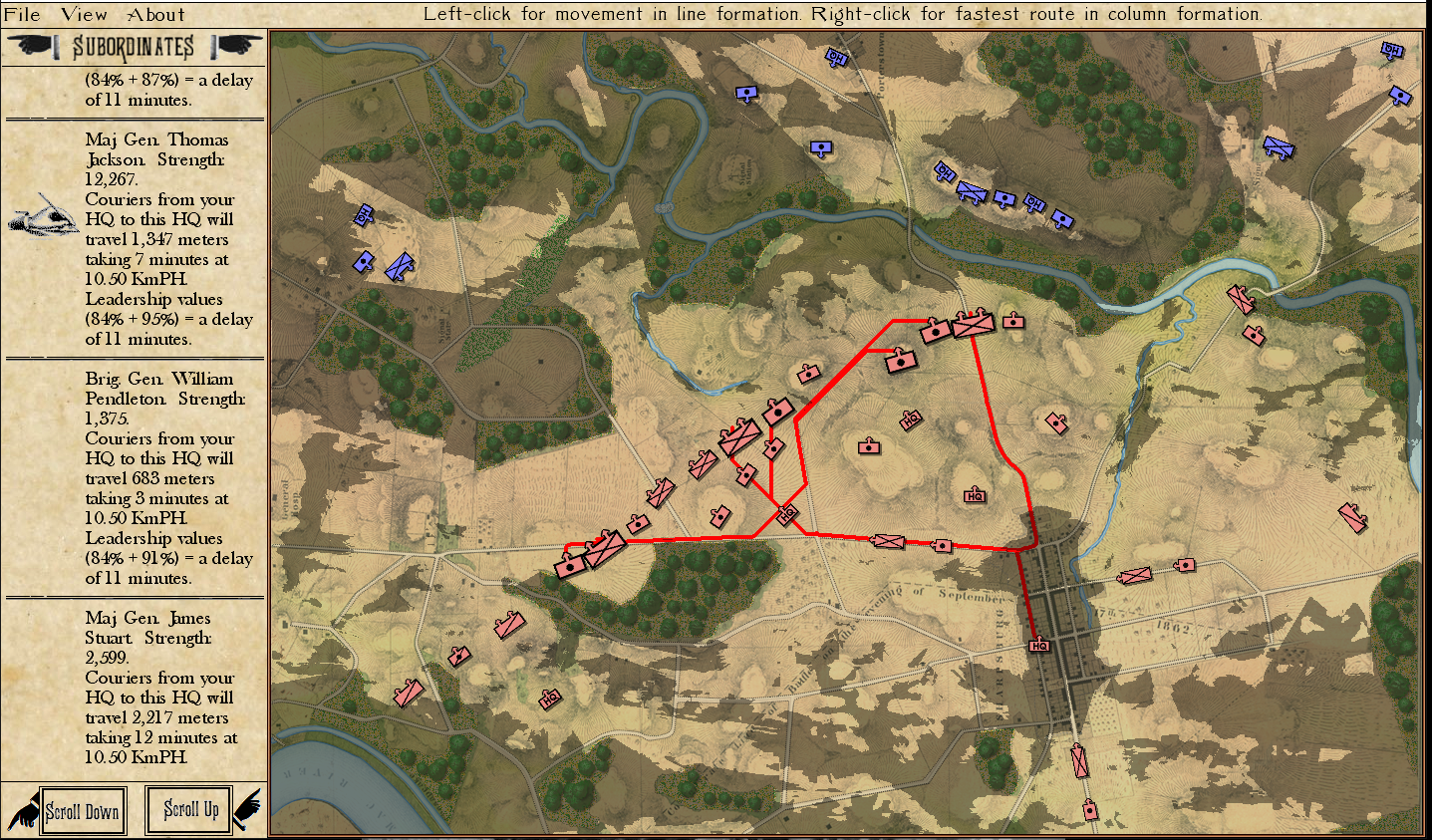
The delay in the transmittal of orders from headquarters and staff is one example of the Friction of War. Note the calculated time for couriers to arrive displayed in the Subordinate Orders list on the left of the screen. The red lines are the routes that couriers from General HQ to Corps HQ to individual units will take. General Staff: Black Powder screen shot. Click to enlarge.
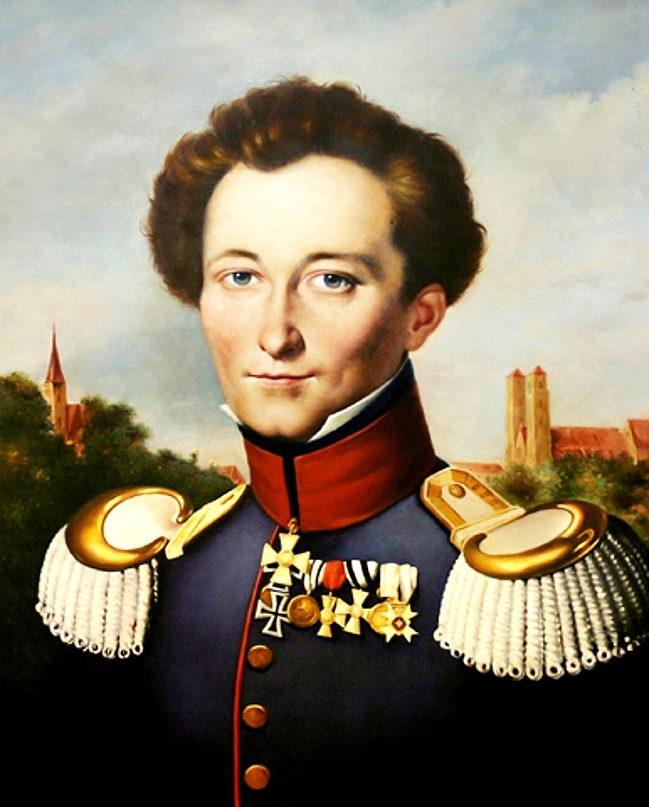
Carl von Clausewitz, in has seminal work, On War, (Book 1, Chapter 7) originated the phrase, “Friction of War”:
Carl von Clausewitz painted by Karl Wilhelm Wach. Credit Wikipedia.
“Friction is the only conception which, in a general way, corresponds to that which distinguishes real war from war on paper. The military machine, the army and all belonging to it, is in fact simple; and appears, on this account, easy to manage. But let us reflect that no part of it is in one piece, that it is composed entirely of individuals, each of which keeps up its own friction in all directions.”
I knew that if General Staff: Black Powder were to be an accurate simulation, and not just ‘war on paper’, that the friction of war would have to be calculated into the command / orders chain. One part of this – the distance the couriers will travel from one headquarters to the next to deliver their orders and the time it takes to travel this distance – can be calculated with reasonable certainty (I’m using the rate of 10.5 kilometers per hour for a horseman, I’m not an expert but this seemed reasonable, and it’s easy to change if somebody has a more accurate value).
Another example of friction of war is factored into the delaying of the arrival of orders is Leadership Value:
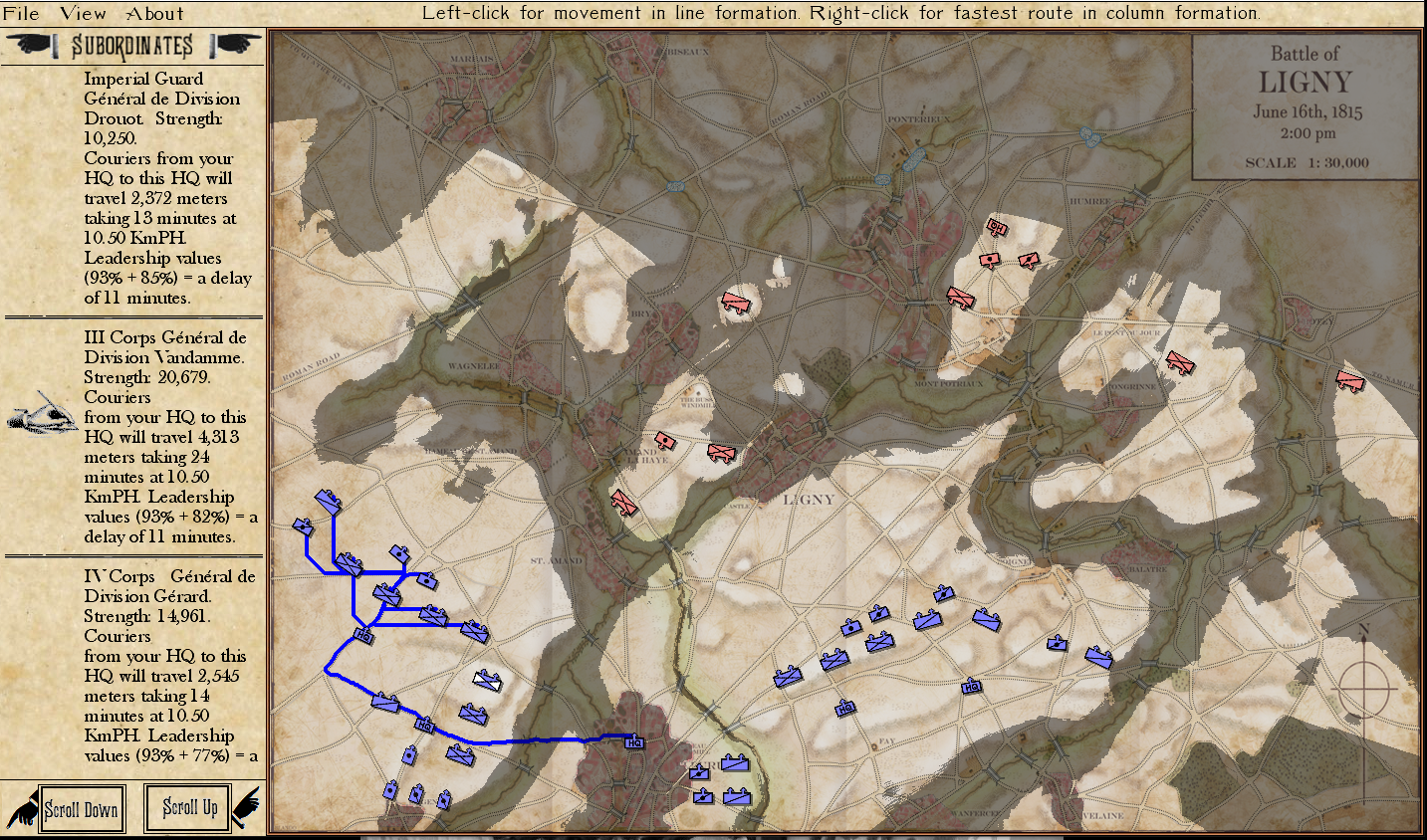
In this example, the Imperial couriers will travel over 4.3 kilometers, taking 24 minutes, to deliver their orders. Also, note the cost of the combined Leadership Values. Because Napoleon and Vandamme have very high Leadership Values little additional delay is added. General Staff: Black Powder screen shot. Click to enlarge.
You can specify at what time the order is to be executed (in this case 6:15), however you can not set a time earlier than when the couriers would arrive. This allows for coordination of attacks across units. General Staff: Black Powder screen shot. Click to enlarge.
The other value – and it is arbitrarily set – is the cost of ineptitude, incompetence, lack of motivation, and sloppy staff work. In the above scenario (Ligny) Napoleon’s Leadership is set at 93%:
The slider adjusts Napoleon’s Leadership Value which effects the delay in issuing orders. General Staff: Black Powder Army Editor screen shot. Click to enlarge.
I understand that Napoleon may have been feeling a bit under the weather during the Hundred Days Campaign. You can set his Leadership Value to anything you want in the Army Editor (above).
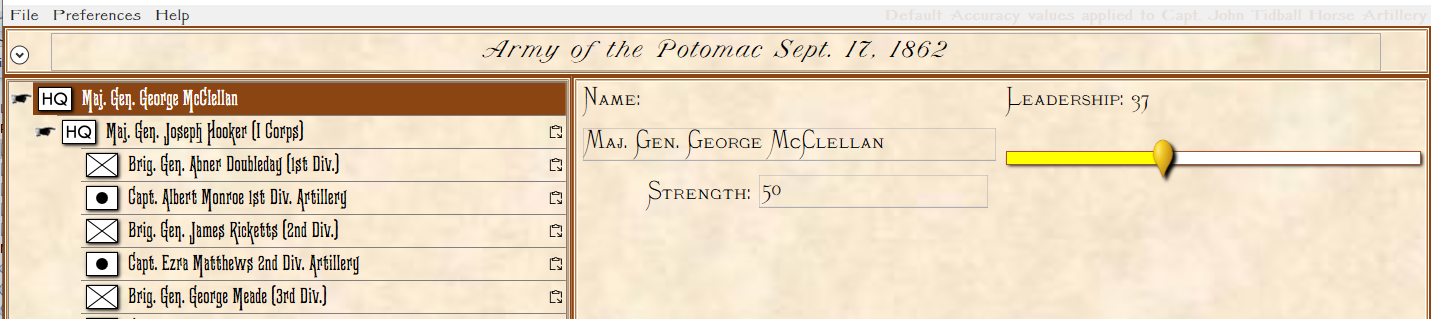
Major General George B. McClellan’s Leadership Value can be changed in the Army Editor. Click to enlarge.
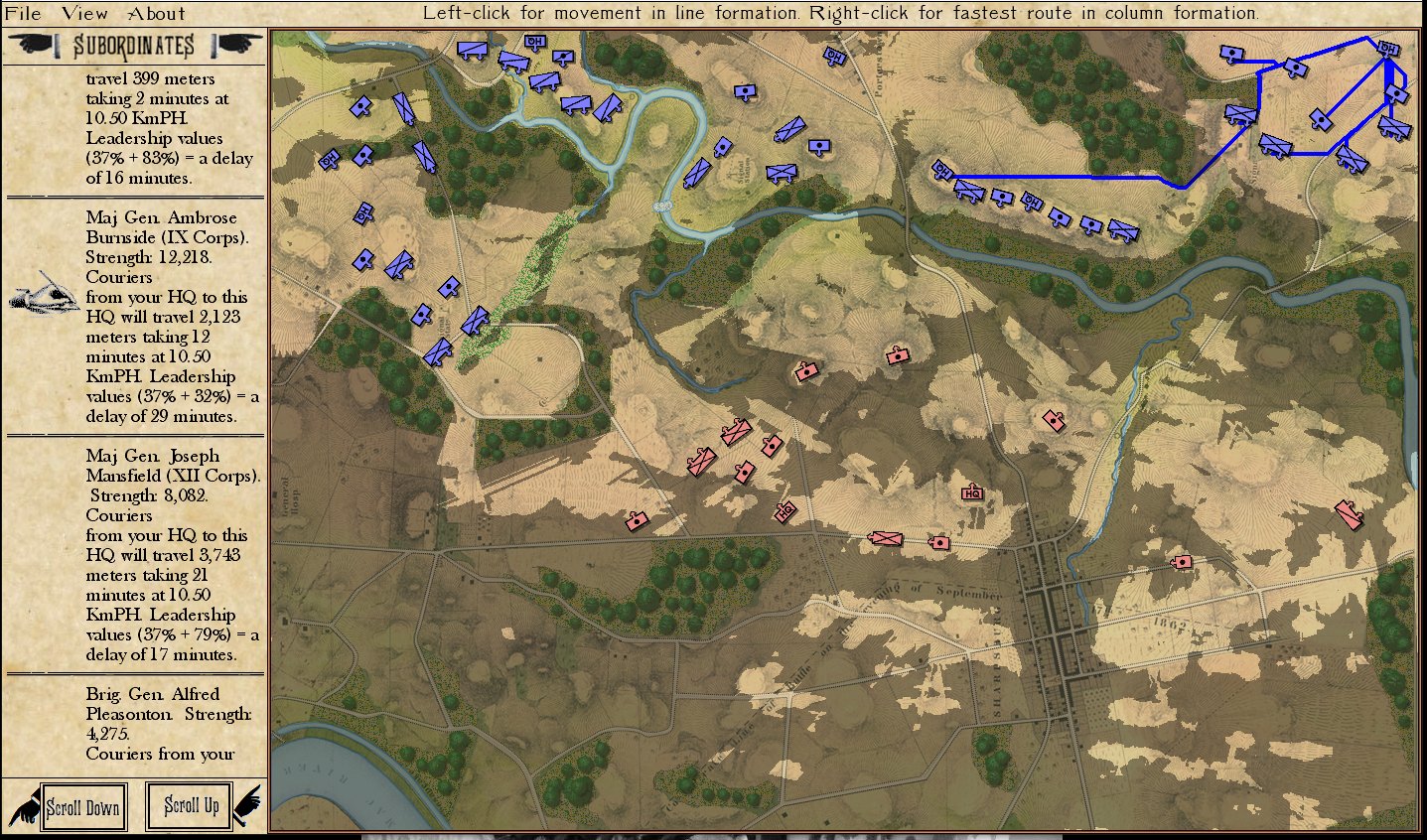
Did I set McClellan’s Leadership Value too low? He was amazingly incompetent. Note below:
The combination of McClellan’s and Burnside’s extremely low Leadership Values adds an additional 29 minutes to the transmittal of orders. The blue lines trace the route that couriers would travel from McClellan’s headquarters to Burnside’s headquarters and then to each division and battery. General Staff: Black Powder screen shot. Click to enlarge.
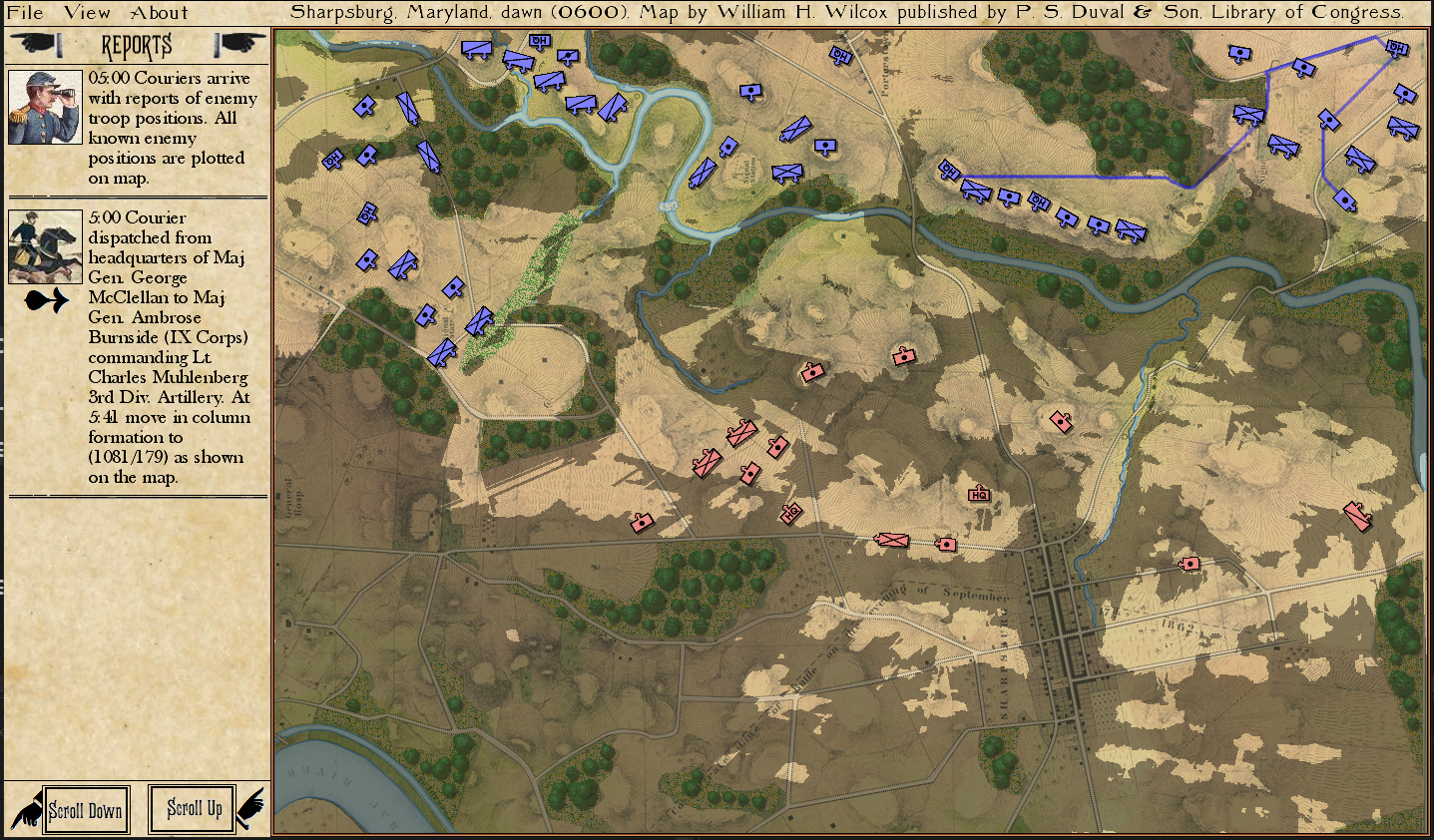
The combination of McClellan’s and Ambrose Burnside’s Leadership Values results in almost a half hour delay in transmittal of the orders (remember after receipt of the orders, Burnside has to send couriers to his divisional and battery commanders, too and their Leadership Values effects the delay before their unit executes the order). After factoring the time it would take for a horseman to travel the distance between McClellan’s headquarters to Burnside’s headquarters (14 minutes) the earliest that a unit could be expected to respond to the original order from General Headquarters would be forty-one minutes later (and, in reality, a bit after that because of that unit’s Leadership Value).
The path of the couriers from McClellan’s headquarters, to Burnside’s Headquarters and then out to the divisions and batteries. General Staff: Black Powder screen shot. Click to enlarge.
I have spent some time at Antietam and studied it at length and this delay of about three-quarters of an hour between the time McClellan wanted to issue an order and the men of Burnside’s IX Corps moved out seems if anything, too optimistic of a timetable. In fact, as I write this, I think I need to increase the penalty for poor Leadership Value. McClellan and Burnside couldn’t possibly have got units moving in less than an hour.
As I have begun playtesting General Staff: Black Powder I found the delay between issuing orders and wanting to see something move now was a bit disconcerting. It shouldn’t have been. I’ve read enough military history to know that battlefield orders were often transmitted the night before and moving units around during the battle could be a risky proposition. Some armies, however, were less afflicted with these problems than others, and that I would attribute to ‘leadership value’ which also encompasses the army’s general staff.
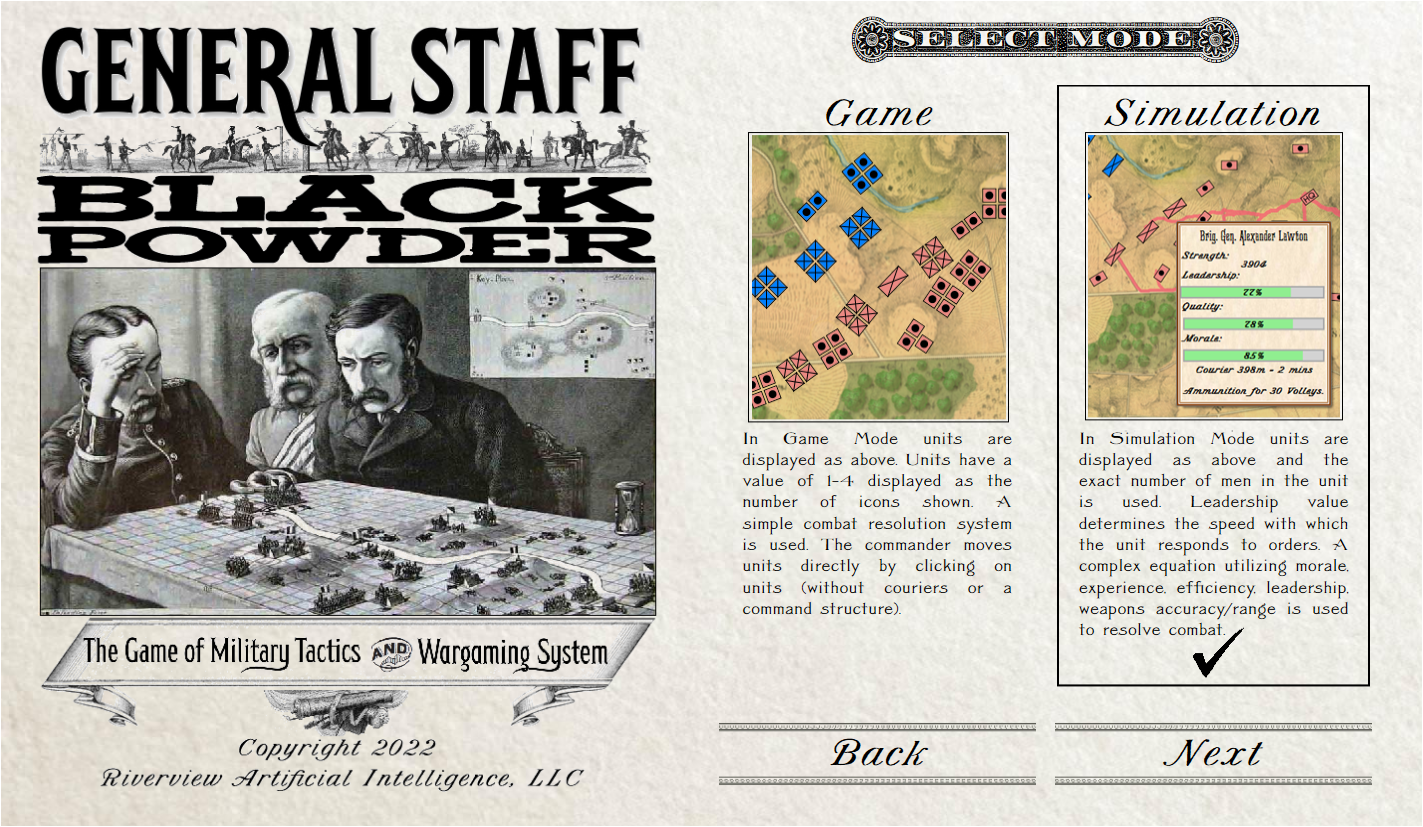
If you don’t want to use General Staff: Black Powder as a simulation that inserts a calculated delay between orders and execution, and would rather just move units instantly, there is ‘Game Mode’:
The Select Mode screen in General Staff: Black Powder. The user chooses between ‘game’ and ‘simulation’ with differences in rules and unit icons. Click to enlarge.
Game Mode has the same maps but uses simpler icons and rules. I originally envisioned Game Mode as a way of introducing wargaming to a new generation (I wanted to write it for the XBox). Anyway, it’s included with General Staff: Black Powder.
Lastly, I know everybody is waiting for news about when can I get my hands on the game?!!?!! My friend, Damien, wasn’t able to work on finishing it using Unity so I’m finishing it up using MonoGame. As you can see I’m pretty far along and I think I will be playing the first ‘actual game’ (that is a simulation from start to finish) within the next couple of weeks; maybe sooner. After that, probably at least another month of fixing bugs, but then I’m hoping to set up a Beta download for all the early backers via Steam. We have a space on Steam but I haven’t even begun to build it out. Obviously, I’m just one guy, I’m working as fast as I can, but I think this is all good news. Also, I’m working on a video to show everything off.
As always, if you have any questions or comments, please feel free to contact me directly.